
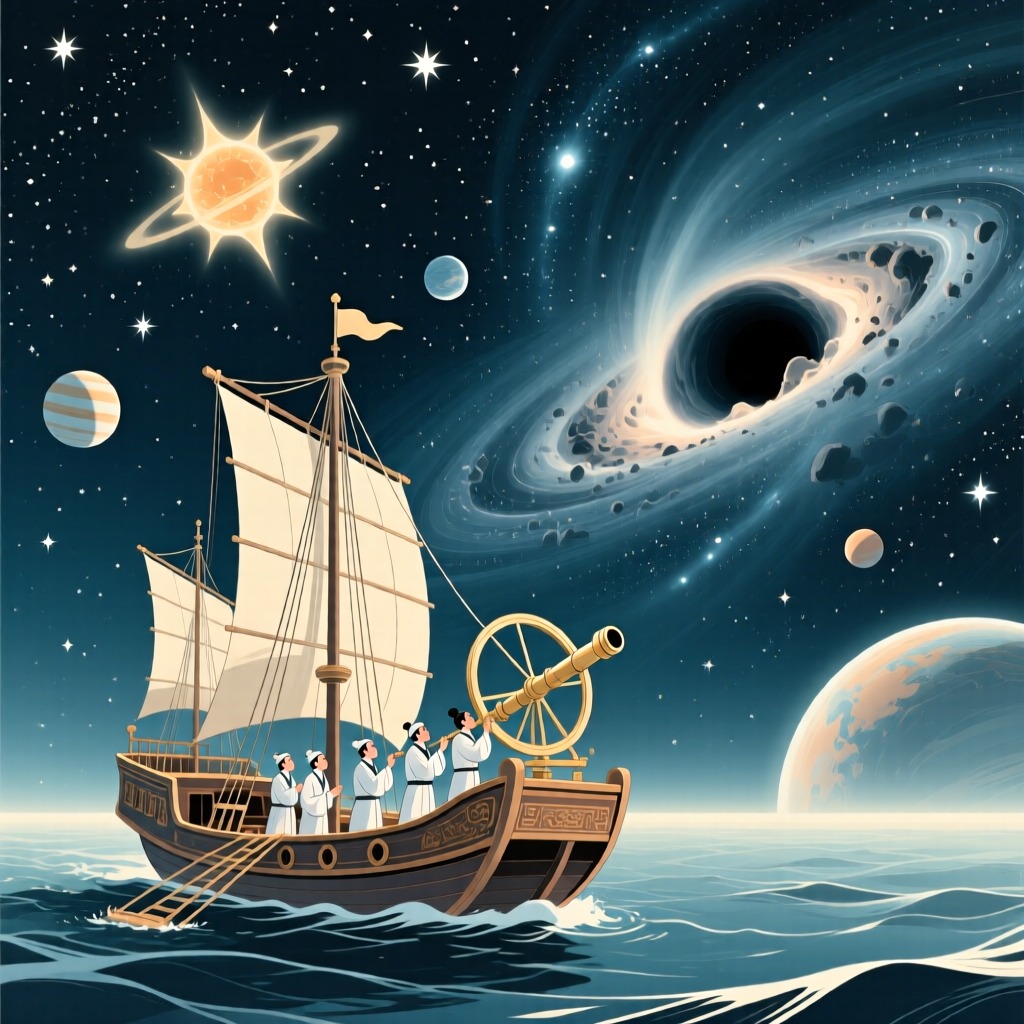

The universe has a history of approximately 11 billion years since the Big Bang. Current observations indicate that the universe is still expanding. In the future, it may continue to expand until it exhausts its energy or, after reaching a critical point, begin to contract. Regardless of the scenario, the universe is destined to come to an end. Scientists speculate that this process could take hundreds of trillions of years. Research by American astrophysicists Fred Adams and Greg Laughlin suggests that in the distant future, the universe may devolve back into a chaotic state composed of subatomic particles.
If the universe continues to expand, stars will exhaust their internal nuclear fuel, eventually transforming into white dwarfs, neutron stars, and black holes. These black holes will consume all matter, including light, plunging the universe into darkness. Over time, black holes will gradually evaporate, and the fundamental particles that make up the universe will decay, leading to a return to a chaotic world.
If the universe begins to contract, the density of matter will continuously increase, the distances between celestial bodies will shorten, and the overall temperature of the universe will rise. Initially, life on planets will be unable to survive, and eventually, the planets themselves will be destroyed. When the temperature of the universe exceeds that of stars, they will disintegrate into gas, and black holes will absorb this material. Black holes will merge, ultimately forming a massive black hole. In the end, even the black hole will evaporate, and the fundamental particles will decay, returning the universe to a chaotic state.
