
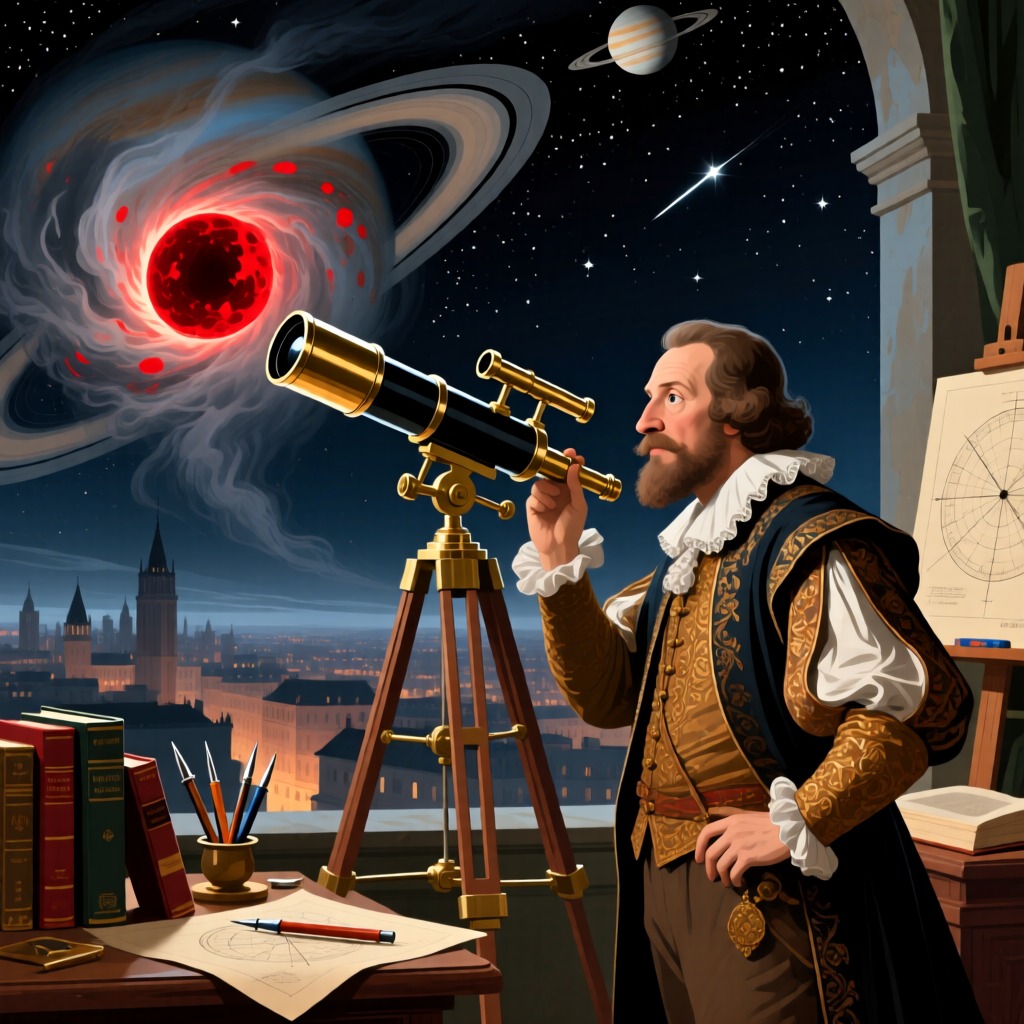

The Great Red Spot is one of the most prominent features on Jupiter, a massive red oval that is strikingly vivid in color, appearing red with a hint of brown. First observed by the Italian astronomer Cassini in 1665, it was used to measure Jupiter's rotation period, a remarkable achievement at the time. Although its color and size can change over time, the Great Red Spot has never disappeared, becoming a long-term subject of scientific study.
This enormous storm typically spans about 14,000 kilometers from north to south, while its length can vary, reaching up to 40,000 kilometers at its longest—equivalent to three times the length of Earth. Its color often appears red with a slight brownish tint, and at times it can even show a bright red or soft rose hue. There are differing opinions in the scientific community regarding the color of the Great Red Spot; some suggest it may contain red phosphorus, while others believe it results from a chemical reaction of certain substances under ultraviolet light from the Sun. These remain unsolved mysteries.
Since the 1970s, observations from spacecraft such as Pioneer 10, Pioneer 11, Voyager 1, and Voyager 2 have revealed that the Great Red Spot is actually a violent cyclone, rotating counterclockwise and completing a cycle every 12 days. This storm system is exceptionally powerful, often described as tumultuous and chaotic. The persistence of the Great Red Spot is attributed to its unique geographical position and the robust airflow system surrounding it.
However, the Great Red Spot is not alone; it has a little sister known as the Little Red Spot. Discovered by Pioneer 10 in 1973, the Little Red Spot vanished by 1974 when Pioneer 11 passed by, existing for only a brief two years. This raises many unanswered questions about why the Great Red Spot has been able to persist for so long.