
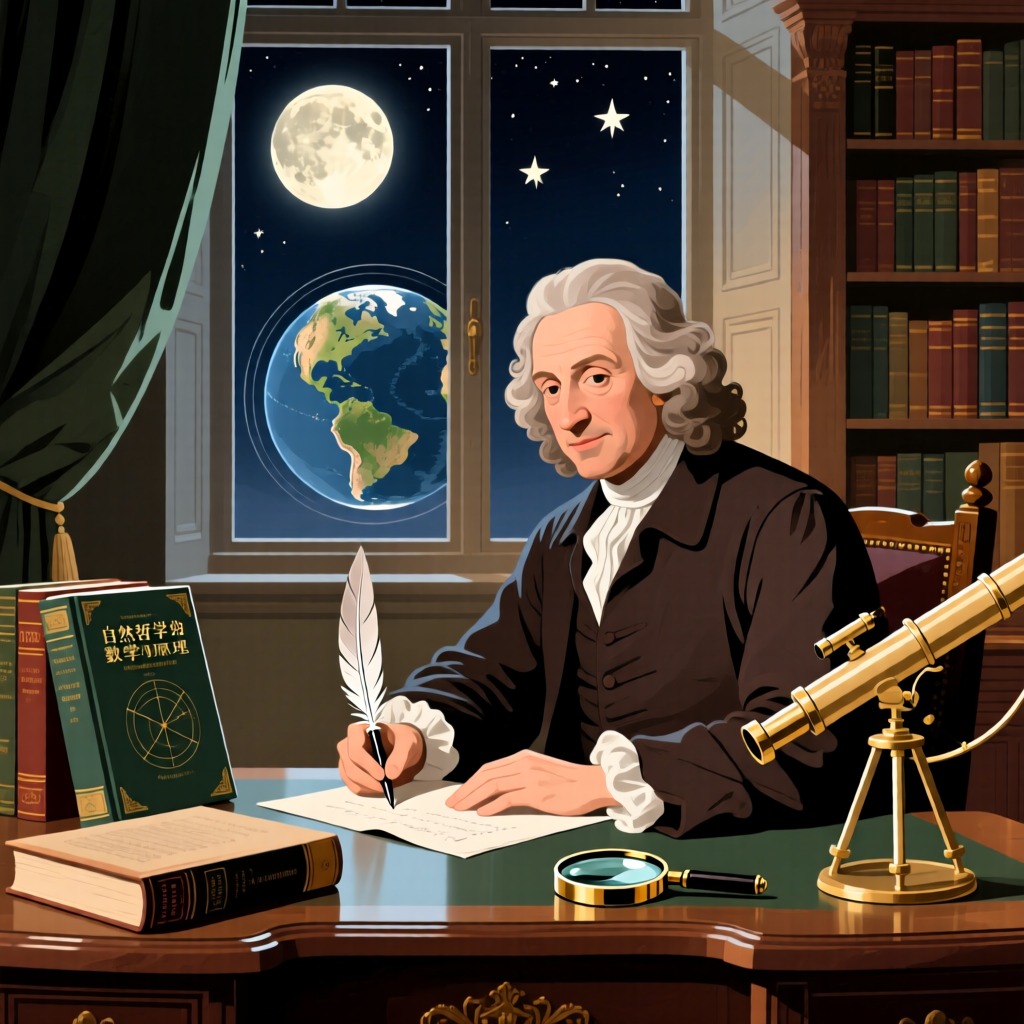

What forces drive the Earth to move ceaselessly—rotating around its axis while orbiting the Sun in an elliptical path, resulting in the alternation of day and night and the changing of seasons, allowing life to thrive?
Astronomers believe that the solar system formed from an ancient primordial nebula. This nebula, influenced by some disturbance and the force of gravity, began to contract toward its center. Over a long period of evolution, the temperature and density of the central material increased, eventually evolving into the Sun. The residual gases surrounding the Sun gradually formed a rotating disk of gas, ultimately creating a complete solar system.
To measure the speed of an object's linear motion, we use velocity. But how do we measure the state of an object's rotation? In physics, one method is to use "angular momentum." The angular momentum of an object rotating around a fixed point is the product of its mass, velocity, and the distance from the fixed point. Newton's law of conservation of angular momentum states that as long as a rotating object is not acted upon by external forces, its angular momentum will not change due to changes in the object's shape. For example, when a ballet dancer spins and suddenly pulls in their arms, their rotation speed increases to maintain a constant angular momentum.
The Earth's rotation and revolution also follow this principle. The primordial nebula originally possessed angular momentum, which was not lost after the formation of the solar system but was redistributed. Each celestial body obtained its own angular momentum during the long evolutionary process from the primordial nebula. Due to the conservation of angular momentum, planets spin faster as they contract. The Earth is no exception; its angular momentum is primarily distributed among its orbit around the Sun, the mutual rotation of the Earth-Moon system, and its own rotation.