
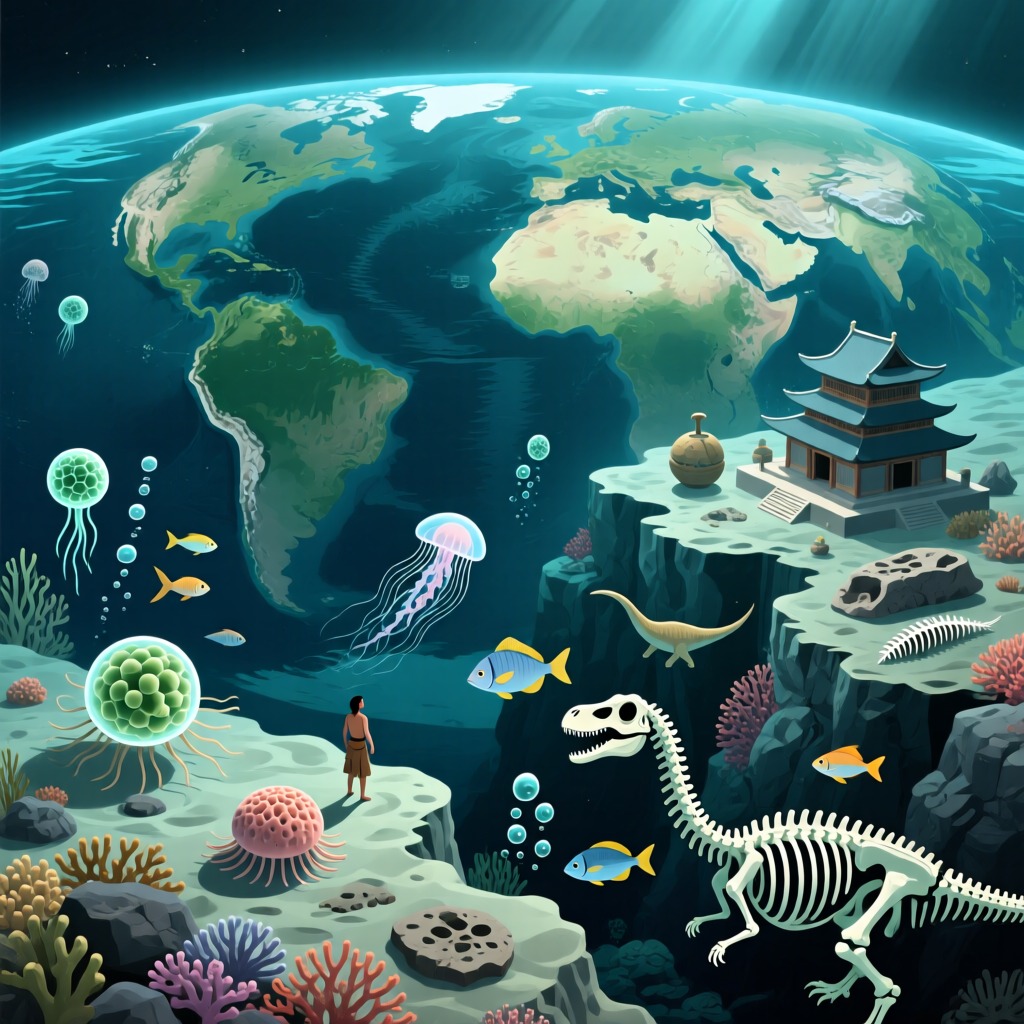

Our planet, Earth, has a history of 4.6 billion years. Over this vast expanse of time, it has undergone countless transformations, ultimately shaping the world we know today. The history of life on Earth is equally ancient, spanning 3.8 billion years, while human history is relatively insignificant in comparison, lasting only two to three million years.
If we were to represent the evolution of Earth as a 24-hour day, the emergence of humans would occur in the last half-minute. During this period, from the birth of the Earth to the origin of life, and through the succession of various species, including the rise and fall of dinosaurs and the emergence of mammals, each step is filled with wonder.
Life on Earth began at the stroke of midnight, and 12 hours later, the ancient oceans witnessed the appearance of the earliest life forms—single-celled organisms. As time progressed, these primitive cells evolved into mollusks, sponges, and algae, followed by the emergence of fish. By 4:48 PM, dinosaurs ruled the Earth until 9:36 PM when their reign was supplanted by mammals. However, all of this came to a sudden halt at 11:20 PM, when the extinction of reptiles marked the end of an era.
It wasn't until 11:59:30 PM that humans first appeared on Earth. The transition from primitive existence to modern society took merely a quarter of a second in this metaphorical day. This reflection is not only a contemplation of time but also a profound respect for nature.
The Earth is both ancient and fresh. While we are familiar with its surface, we know very little about its deeper secrets.