
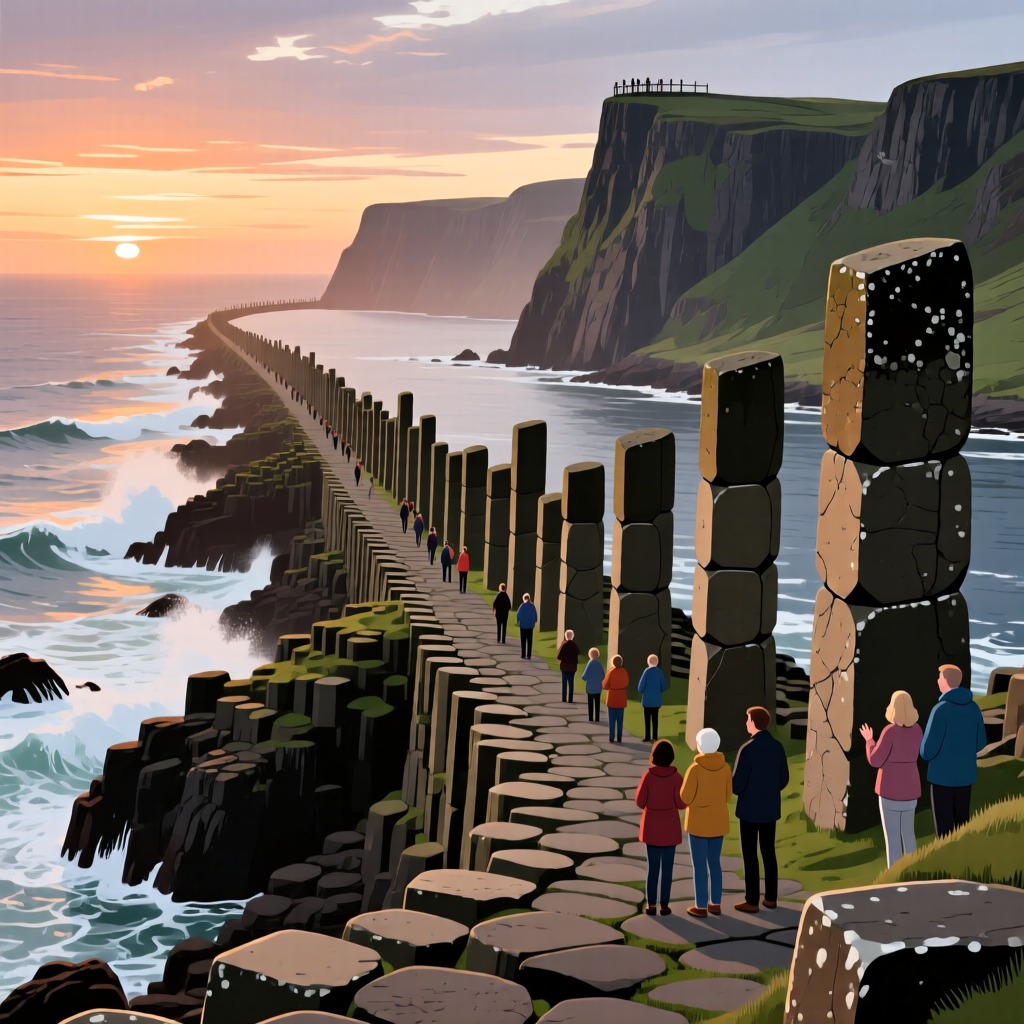

There is a myth about an Irish giant named Finn McCool, who built a road from his home in County Antrim, Northern Ireland, across the Atlantic Ocean to the Hebrides, where his rival, the Scottish giant Benandonner, lived. However, the cunning Benandonner took the initiative and arrived in Ireland before Finn could act. Finn's wife cleverly deceived Benandonner by claiming that Finn was her sleeping baby. Terrified, Benandonner thought that if the baby was so enormous, then his father must be even larger. In a panic, he fled to safety by the sea, destroying the path behind him so that it could no longer be used.
Another legend tells a much more peaceful and romantic story. It is said that Finn MacCool, a warrior of the ancient Irish king of Tara, fell in love with a tall beauty from the island of Staffa in the Inner Hebrides. To marry this beauty without her getting her feet wet, Finn constructed a stone road leading to Staffa.
Today, at the Giant's Causeway on the northern coast of Ireland, we can see thousands of hexagonal columns, which are said to be the work of Finn McCool. Most of these columns stand about 6 meters tall, fitting together to form a honeycomb structure that stretches into the sea. From above, the causeway appears as a man-made road extending over 270 kilometers along the coast, reaching out into the Atlantic Ocean. These rock formations, standing at the edge of the sea for millions of years, captivate countless visitors with their orderly arrangement and stunning shapes.
The columns at the Giant's Causeway are categorized into three groups: the Grand Causeway, the Middle Causeway, and the Small Causeway. People have amusingly named these columns with quirky titles, such as the "Chimney Tops" and the "Horseshoe" viewing platform, separated by cliffs.