
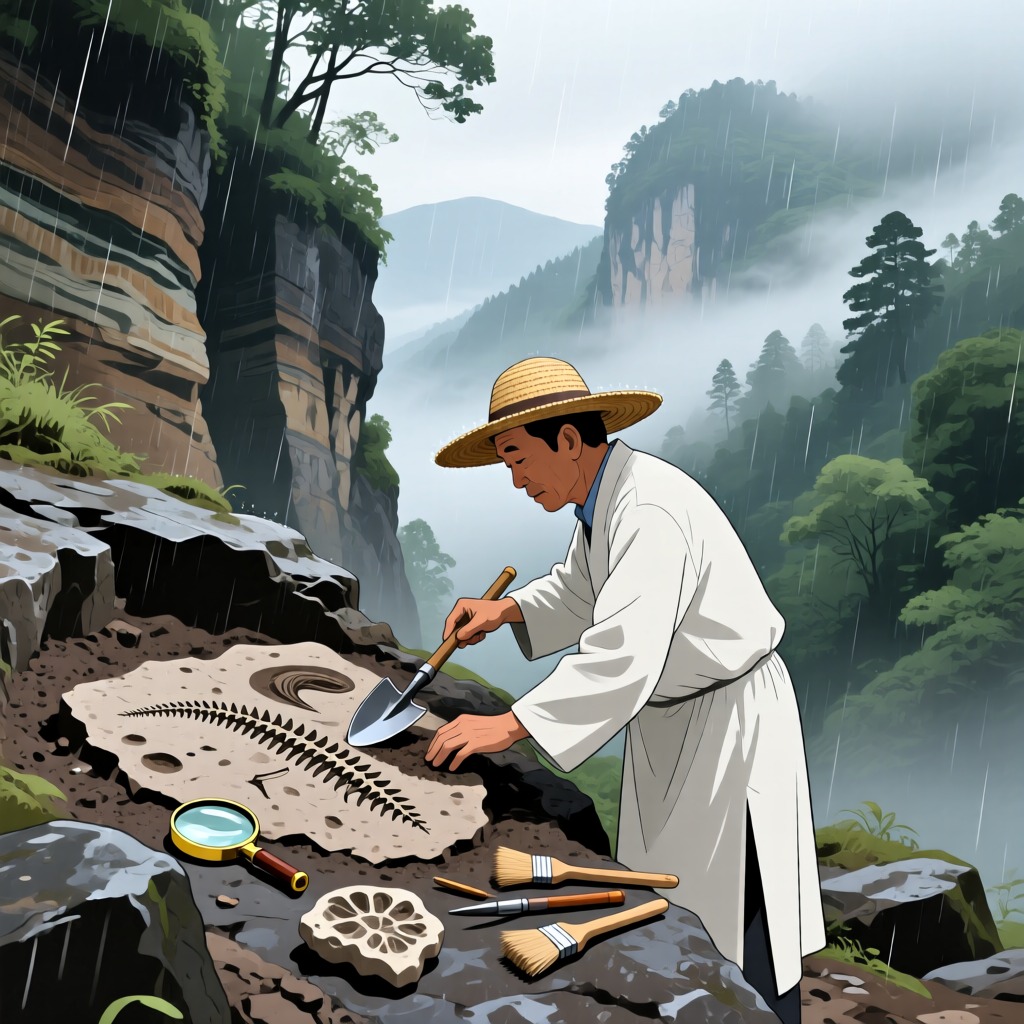

The mystery of the Cambrian explosion has captivated scientists since the discovery of ancient fossils in Chengjiang, Yunnan, which shocked the world. In 2002, the fourth ancient fish fossil specimen was unearthed near Mahuang Village in Haikou, China, sparking widespread academic interest. This fossil further confirmed that the ancestors of vertebrates emerged during the great explosion of life 530 million years ago, posing new challenges to Darwin's theory of evolution.
The Chengjiang fossils clearly show the head, dorsal fin, mouth, and eyes of what can be identified as a 'fish'. This fossil fish belongs to the most primitive group of soft-bodied vertebrates known as the Agnatha. Paleontologists point out that because soft tissues are difficult to fossilize, they are only preserved under extremely rare conditions, providing a valuable opportunity to understand primitive life. This well-preserved soft-bodied ancient fish further demonstrates the unique value of the Chengjiang fossil site.
Vertebrates represent a crucial stage in the history of life's evolution. The emergence of bony fish was undoubtedly a significant event. In 1999, paleontologists from the Yunnan Geological Science Research Institute discovered two vertebrate fossils in the Haikou area of Kunming, naming them 'Haikou Huaxia Fish' and 'Zhongxin Fish', which are considered the earliest vertebrates in the world. Professor Hou Xianguang and his team conducted in-depth research and confirmed that these fossils belong to the same category as the Haikou Huaxia Fish and Zhongxin Fish, revealing important clues about the origins of vertebrates.
On July 1, 1984, Hou Xianguang began fossil excavation work at the Miao Tian Mountain by Fuxian Lake in Yunnan. That afternoon, he unexpectedly discovered a fossil never seen before, which thrilled him. This fossil became a landmark for the Chengjiang biota and attracted the attention of world-renowned paleontologists. The Chengjiang biota fossils now number over 120 species, including various bizarre groups such as sponges, cnidarians, and arthropods. Hou Xianguang's research not only corrected previous misconceptions but also proposed many new scientific viewpoints.