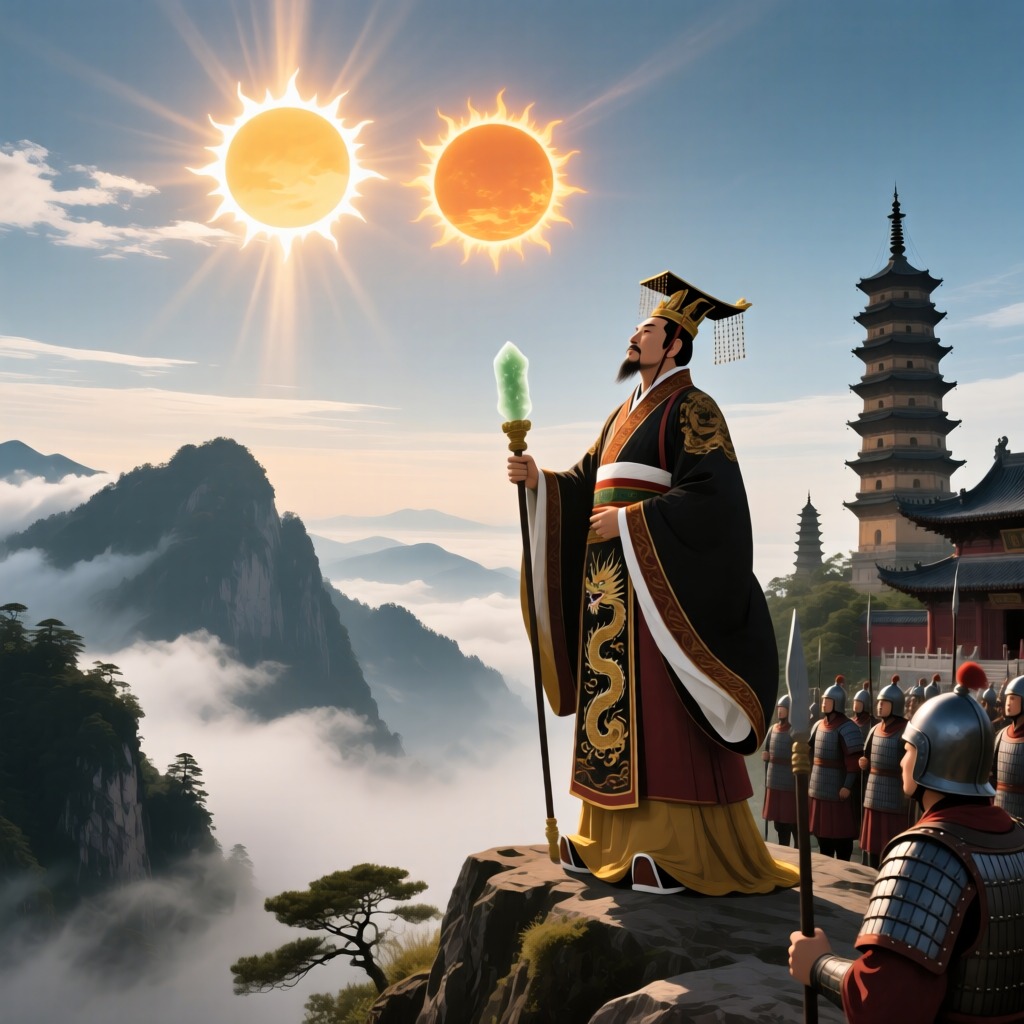

In ancient mythology, the story of "Hou Yi Shoots the Suns" describes a time when ten suns appeared in the sky. While this is a beautiful legend, there have indeed been historical records of strange phenomena involving multiple "suns" in the sky. For instance, during the Chenqiao Mutiny led by Zhao Kuangyin, the founding emperor of the Northern Song Dynasty, two suns were seen in the sky, a spectacle that seemed to foreshadow his impending ascension to the throne.
On August 24, 1933, two suns suddenly appeared on either side of the sun over Mount Emei in Sichuan, capturing significant public attention. Earlier that same year, on January 22 and 23, three suns were seen lined up in the sky over the ancient city of Xi'an. Again, on May 7 and June 2, 1965, the Pukou area of Nanjing witnessed the rare sight of three suns appearing simultaneously. Although our solar system has only one sun, what causes these mysterious "multiple suns" to appear?
It turns out that these are natural phenomena caused by atmospheric changes. At altitudes of 6 to 8 kilometers, the temperature is extremely low, and a large number of ice crystals gather. When sunlight hits these ice crystals, they refract the light like a prism, creating beautiful halos—known as halos. Scholar Lovitz from Petersburg witnessed this spectacular phenomenon in the summer of 1970. He saw two halos of different sizes surrounding the sun, with bright arcs above and below, resembling two wide cow horns. A white light band crossed between the sun and the halos, and six dazzling sundogs appeared in the sky. These halo phenomena lasted for five hours.
Despite the seemingly magical nature of these phenomena, they are actually caused by optical principles, with the real sun being the only one; the others are merely illusory light shadows.