
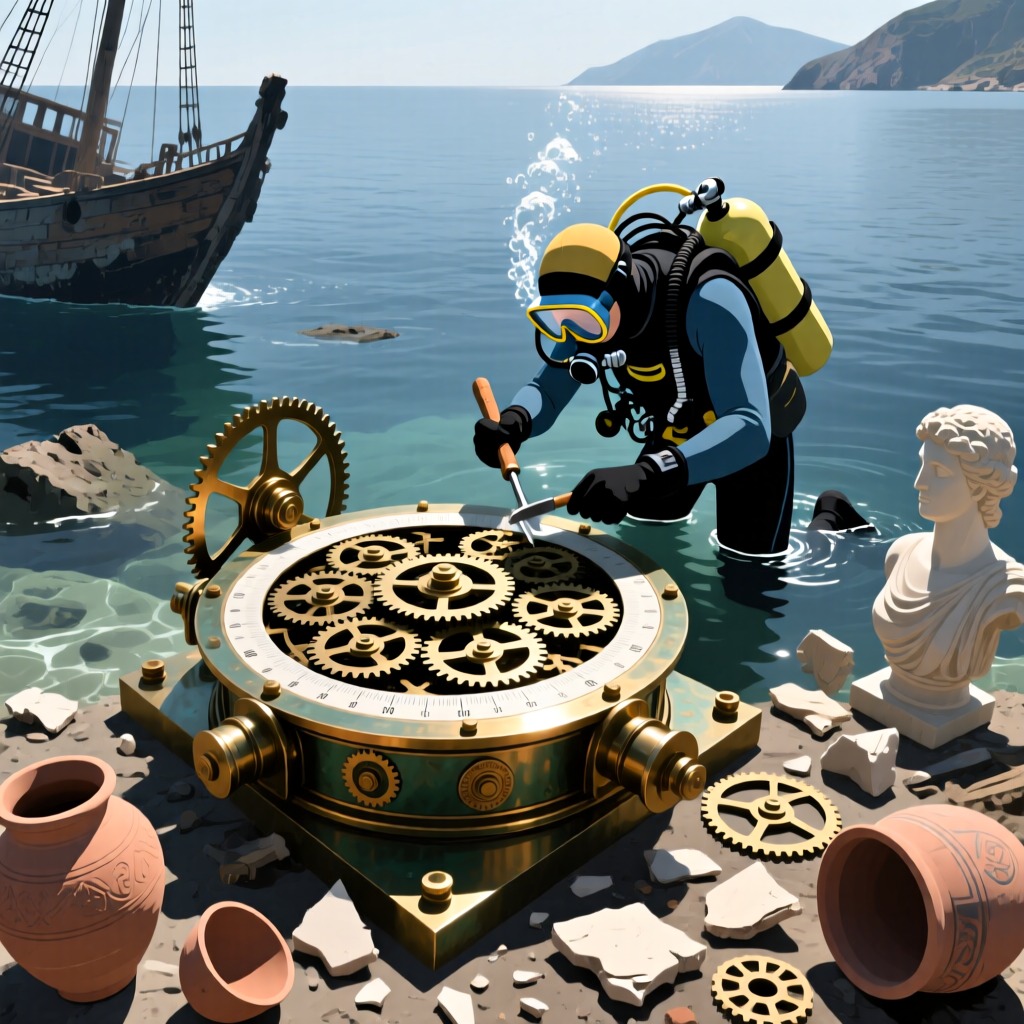

In the early 20th century, a Greek diver discovered a sunken ship in the Antikythera Strait. After recovery and expert analysis, it was determined that this ship sank around the beginning of the Common Era. Among the precious artifacts, it concealed a shocking secret—a complex bronze device. This device is adorned with intricate scales, movable pointers, and rotating gears, and even features engraved inscriptions. After extensive cleaning and disassembly, experts confirmed that this is a sophisticated mechanical device used for calculating celestial movements. Comprising over 20 small gears, winding mechanisms, and crown gears, it can simulate the trajectories of the sun, moon, and other planets. Incredibly, this technology was not invented until 1642 by Pascal, yet the ancient Greeks had mastered such advanced knowledge as early as 82 BC.
This discovery not only challenges our understanding of ancient Greek technological capabilities but also raises the question: who created this machine? If it indeed was made by the ancient Greeks, the history of Greek technology would need to be completely rewritten. However, there is no mention of such machinery in ancient Greek literature, making the issue even more perplexing. Could it have been the work of an intelligence far beyond that of ancient Greek civilization?