
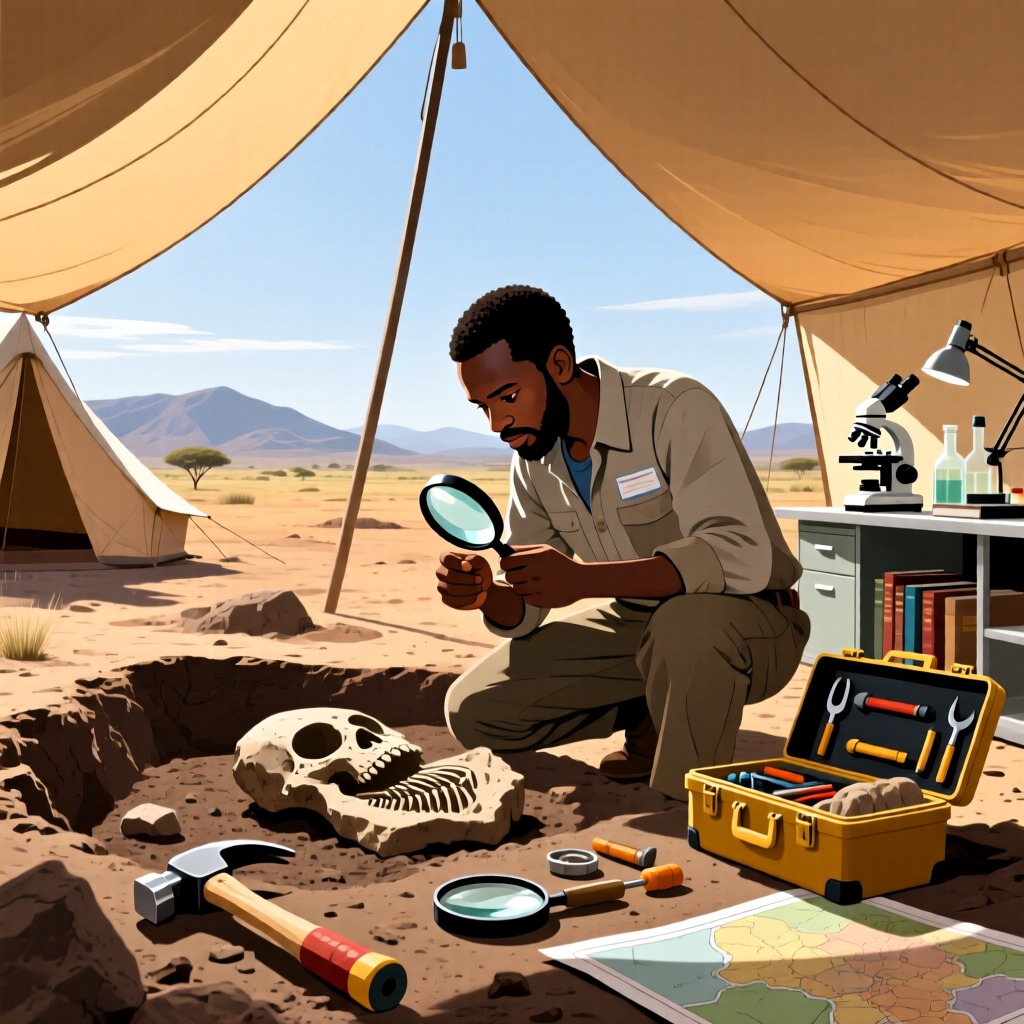

The origins of modern humans, or Homo sapiens, date back approximately 40,000 to 50,000 years, a time when there were almost no physical differences between them and today's humans. During this period, the climate began to warm, allowing humans to move beyond caves and settle in plains. Evidence of human presence can be found in every corner of the Earth, except for the polar regions. But what exactly defines modern humans, and how did they evolve?
Compared to early Homo sapiens, modern humans have flatter faces, smaller teeth, reduced brow ridges, and an increased brain capacity of over 1,400 cubic centimeters. Their physical structure indicates that they were fully capable of upright walking. The emergence of modern humans marks the final stage of human physical evolution.
There are two main hypotheses regarding the origins of modern humans in academia. The multiregional evolution hypothesis suggests that modern humans evolved from local populations of Homo erectus in various regions, while the African origin hypothesis posits that modern humans originated in Africa and gradually spread across the globe. Both hypotheses have their supporting evidence, but the truth remains elusive.
One of the earliest fossils of modern humans was discovered in northeastern Ethiopia, including a skull of an adult male, a child, and an adult. These fossils indicate that the facial features of modern humans were already present. The Cro-Magnon people from France are among the earliest known modern humans, while fossils from Africa show forms close to modern humans. However, the dating and reliability of these fossils are still debated.
The Neanderthals, as a transitional form between modern humans and Homo erectus, have sparked further discussion. Did modern humans evolve from Neanderthals, or from other types of Homo? What was the fate of the Neanderthals? These questions require more archaeological evidence for answers.