
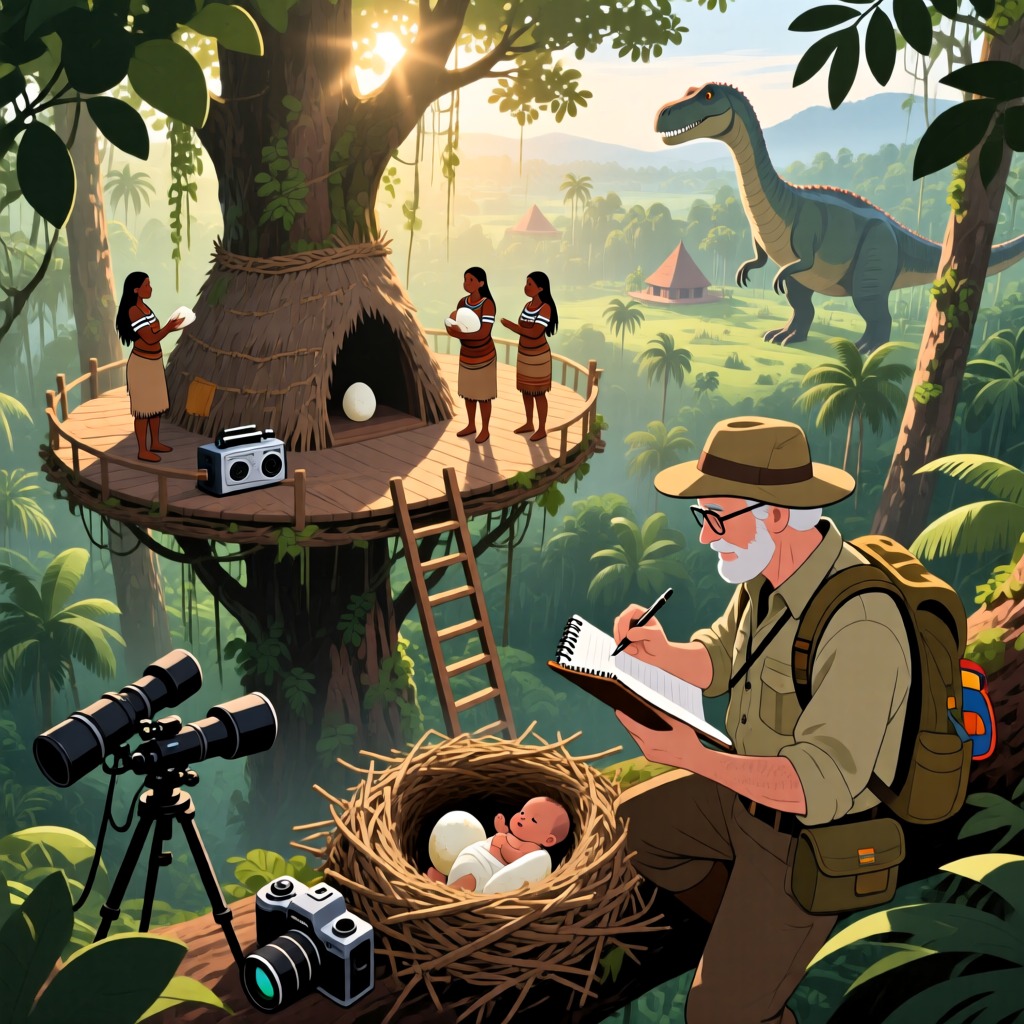

Recently, an expedition team made a shocking discovery in a primeval forest in Borneo, Indonesia: a surviving prehistoric human tribe. This tribe's infants are all hatched through oviparous means, leading to the term "oviparous humans."
The team, led by German anthropologist Dr. Lau Wofez and ten other members, ventured deep into the tropical rainforest to find this last remaining primitive tribe. They were astonished to discover that these indigenous people live on large tree platforms, stand about 1.2 meters tall, and are mostly naked, primarily feeding on giant earthworms. Female tribe members give birth to a large egg after six months of pregnancy, followed by a three-month incubation period, ultimately producing infants through oviparous means.
As the expedition members interacted with the tribe, they gradually became familiar with their way of life. The women nurse the newly hatched infants with milk, a process strikingly similar to modern human reproduction. This discovery not only challenges traditional theories of human evolution but also sparks new discussions about human origins: could dinosaurs truly be our ancestors?
These findings could redefine the history of human evolution, especially when the fetus from the dinosaur egg is born, prompting anthropologists to further explore and research, potentially revealing more secrets about human origins.