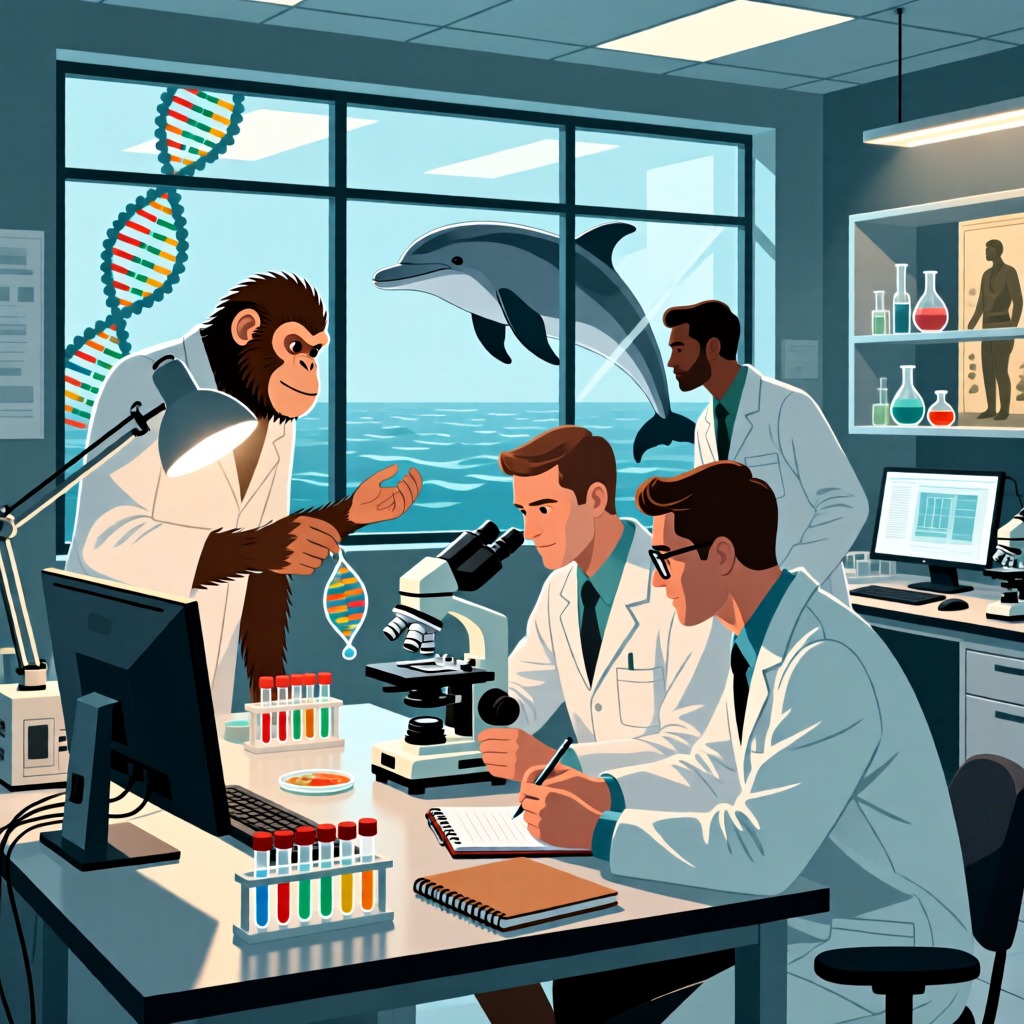

The mystery of human ancestors: the debate from apes to dolphins.
The notion that humans evolved from ancient apes has long been accepted as a conclusion. Since Darwin published 'On the Origin of Species' and 'The Descent of Man', the idea that humans evolved from apes has become deeply ingrained. However, with advancements in biological sciences, new theories have emerged that challenge traditional views.
American geneticist Morgan proposed the 'genetic gene theory', evolving evolution into 'modern Darwinism'. Following this, scientists from Japan and the United States introduced the 'new evolution theory' based on achievements in molecular genetics. While these new theories do not deny that ancient human ancestors came from apes, they offer a new theoretical framework.
Recently, a French physician named Michael L. Auden presented a shocking viewpoint: 'Humans are more closely related to dolphins than to apes, and our ancestors are dolphins.' He supports this claim by examining various aspects such as human physiological traits and behavioral habits.
Between the opposing views of 'human-ape common ancestry' and 'human-dolphin common ancestry', anthropologists have proposed the 'sea ape theory'. British anthropologist Alice T. Hardy believes that 4 to 8 million years ago, due to rising sea levels, ancient apes were forced to adapt to life in the sea, becoming sea apes. About 4 million years later, as the seas receded, these sea apes returned to land and evolved towards modern humans.
Molecular biologists, through DNA comparisons between humans and primates like chimpanzees and gorillas, have found that humans share a very close relationship with chimpanzees and gorillas, which seems to provide strong scientific evidence for the common ancestry with apes. However, whether human ancestors are apes or dolphins remains a difficult question to answer.