
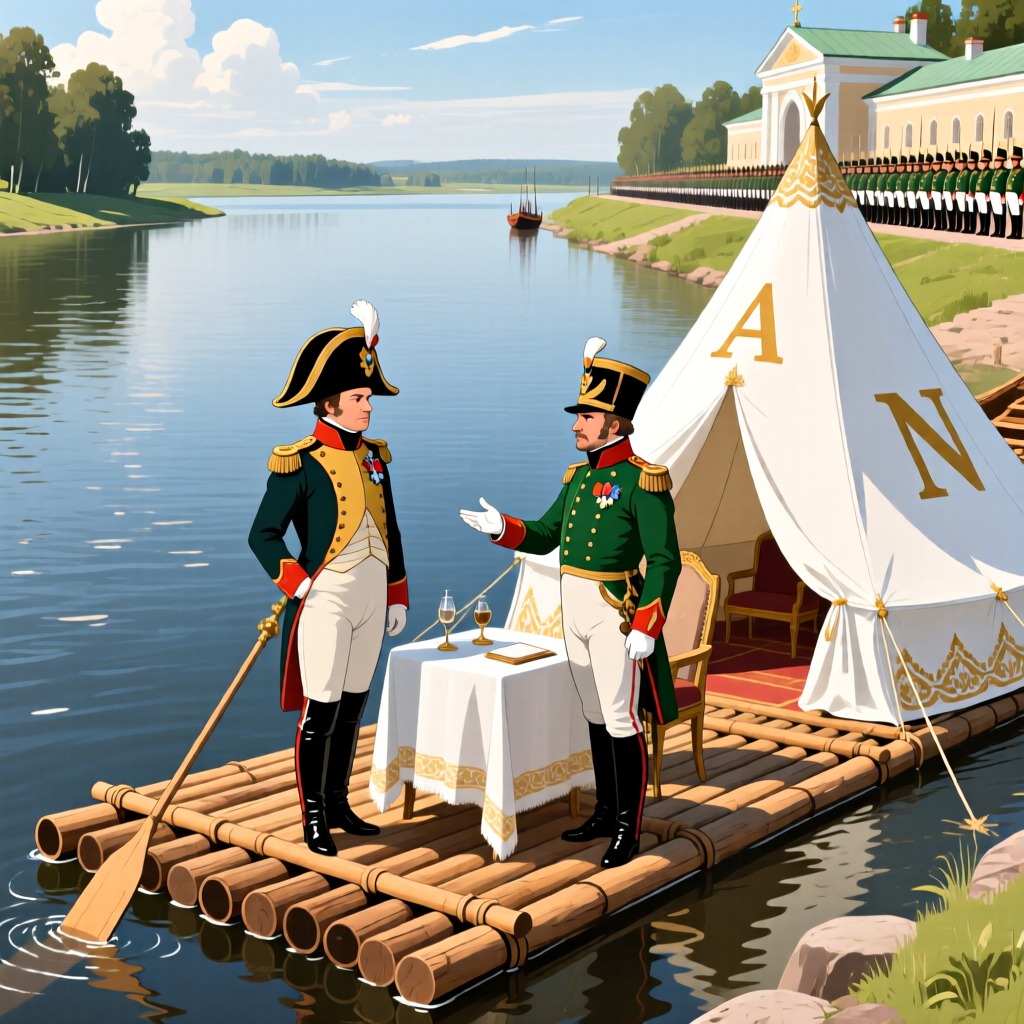

Since 1807, many historians have attempted to uncover the secrets of the Tilsit Conference, yet the full details remain elusive. Napoleon I and Alexander I held several private meetings on a raft over the Neman River, ultimately leading to the signing of a peace treaty and a secret alliance. What topics did the two emperors discuss during their meetings? What were their true positions? These mysteries continue to perplex historians.
On June 25, 1807, the sun shone brightly over the Neman River. French Emperor Napoleon I met with Russian Tsar Alexander I on a raft. Napoleon was dressed in the uniform of the Imperial Guard, wearing his legendary bicorne hat, while Alexander donned a green military uniform with white trousers and a general's hat. The two men shook hands and embraced under the sun, the atmosphere tense yet hopeful. Napoleon proposed that both sides appoint secretaries to collaboratively address international issues. Alexander expressed his hatred for Britain and his willingness to support Napoleon against them. Napoleon responded that such cooperation could lead to peace. This meeting laid the groundwork for the Franco-Russian treaty.
On July 7, France and Russia signed the Treaty of Peace and Friendship. The treaty was notably lenient towards Russia, which not only retained its territory but also gained some Prussian land. Russia promised to act freely against Sweden and Turkey, and in exchange, it had to recognize Napoleon's military achievements. Additionally, Russia committed to mediating peace between Britain and France; if Britain refused, it would join the Continental Blockade. These arrangements reveal Alexander's true stance towards Britain.