
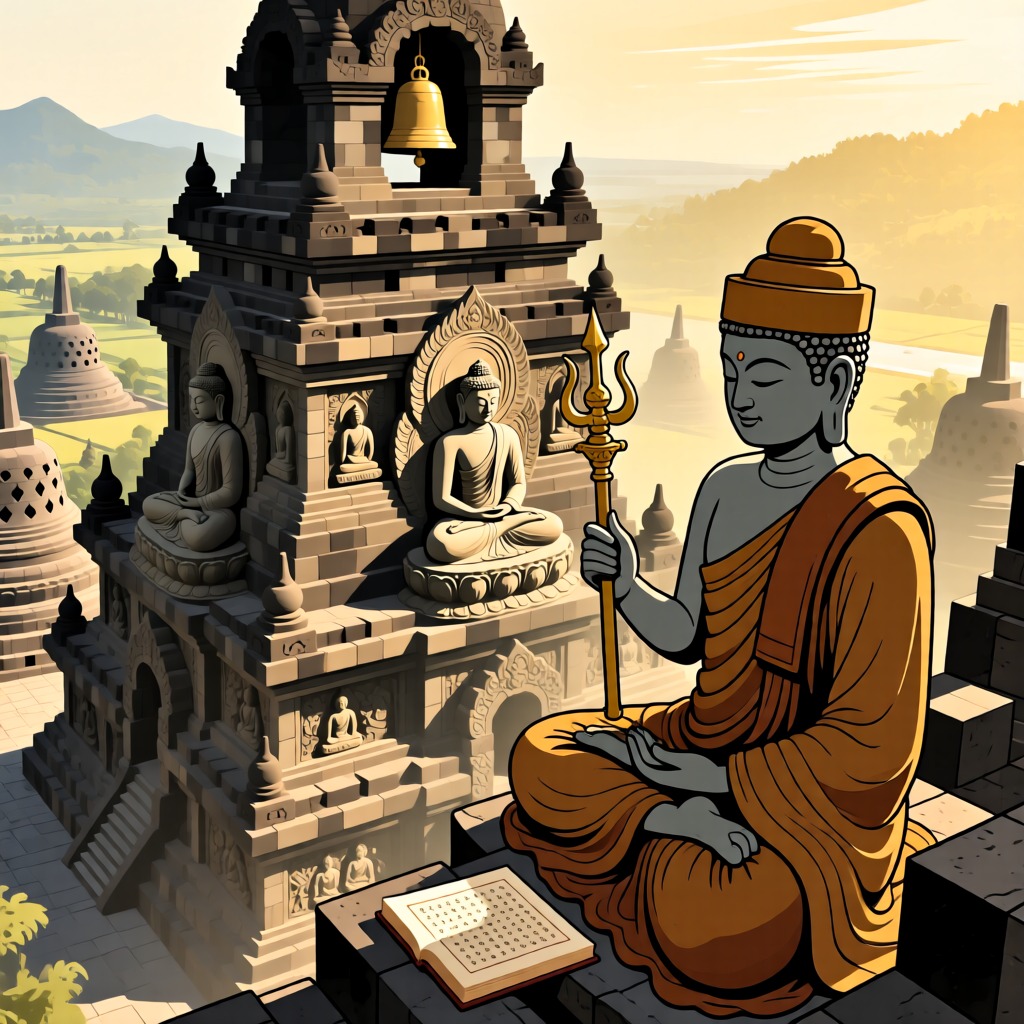

Borobudur, located in Indonesia, is the largest Buddhist stupa in the world and is hailed as one of the four great wonders of Eastern civilization. This stupa blends Indian Buddhist culture with indigenous Indonesian traditions, showcasing a unique historical landscape. The base of the stupa is adorned with 160 reliefs, while the body and surrounding walls feature over 1,300 exquisite carvings that depict the life of the Buddha and various Buddhist stories, as well as some local folklore.
The name Borobudur comes from the Indonesian language, where 'Boro' means 'temple' and 'Budur' translates to 'hill', thus the entire structure is also referred to as the 'Temple of a Thousand Buddhas'. Inside the stupa, there are more than 1,000 Buddha statues and over 1,400 reliefs. The identity of its designer remains a mystery, though it is believed to be linked to King Samaratungga. The construction of the stupa dates back to between 772 and 830 AD, but the exact timeline is unclear. The structure and decorations are filled with enigmatic elements, and many of the statues and reliefs conceal profound Buddhist teachings that remain largely undeciphered.
The architecture of Borobudur frequently features the numbers 8 and 10; for example, the small stupas on the three-tiered circular platforms number 32, 24, and 16 respectively, with a total of 504 Buddha statues and 73 stupas. These numbers hold special significance in Buddhism, reflecting the concepts of emptiness and reincarnation. Despite having stood for a millennium, the stupa still retains many unsolved mysteries, waiting for future generations to explore and uncover.
