
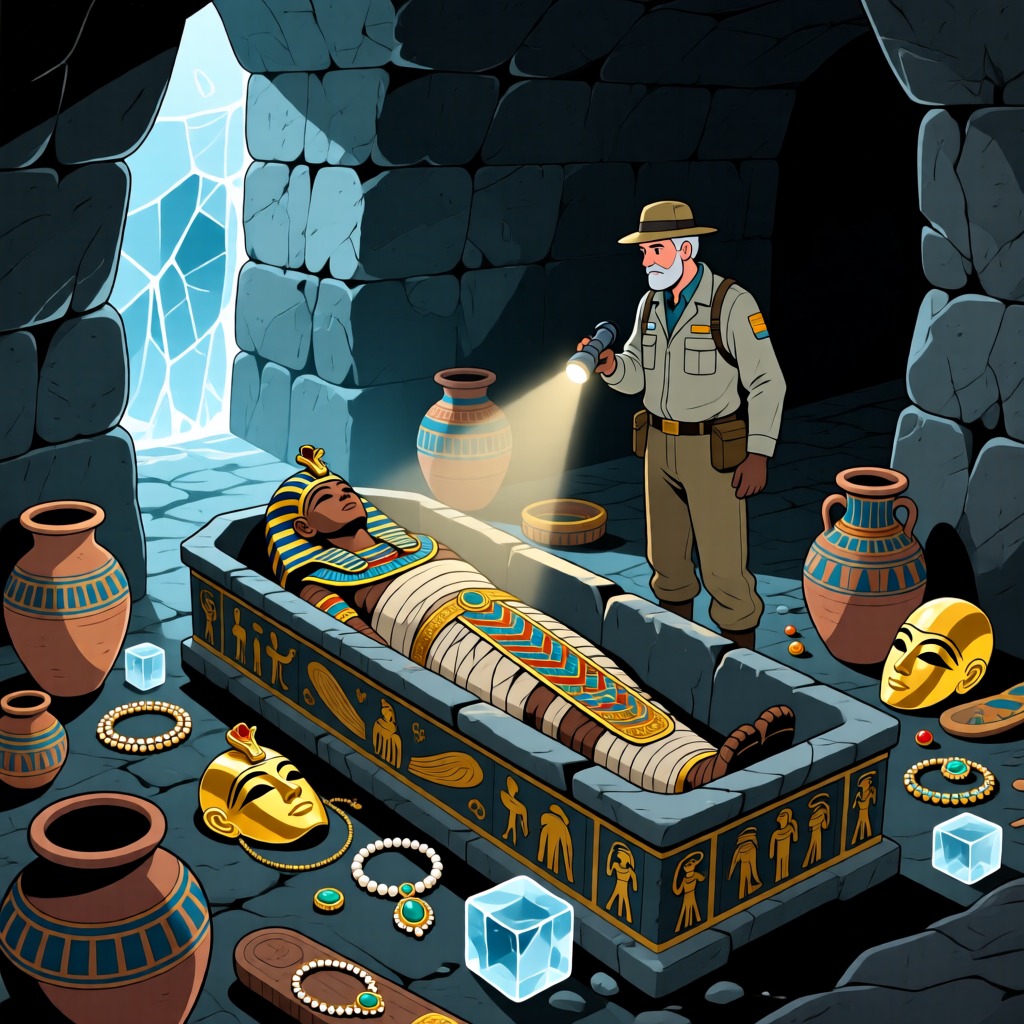

Long ago in ancient Egypt, there was a Pharaoh named Osiris who taught people skills such as agriculture, winemaking, and mining, earning the love of his subjects. However, his brother Set, consumed by jealousy, devised a plot to drown Osiris in the Nile River. Osiris's wife went through great lengths to retrieve his body and ultimately mummified him. With the help of the gods, Osiris was resurrected and became the Pharaoh of the underworld, responsible for judgment.
The process of mummification is intricate, involving steps such as locating the body, purification, dissection, embalming, and wrapping. Each Pharaoh underwent this ritual after death in hopes of rebirth in the afterlife. As time passed, people's faith in mummies grew stronger, with some even believing that cryogenic freezing could achieve the revival of life.
In 1954, archaeologists discovered an untouched tomb in Saqqara, which baffled them as the sarcophagus was found to be empty. Meanwhile, in distant Siberia, mummies and burial goods remained intact within ice-encased graves. These findings provoke thought about whether there are scientific secrets hidden behind the ancient Egyptians' beliefs in mummies.