
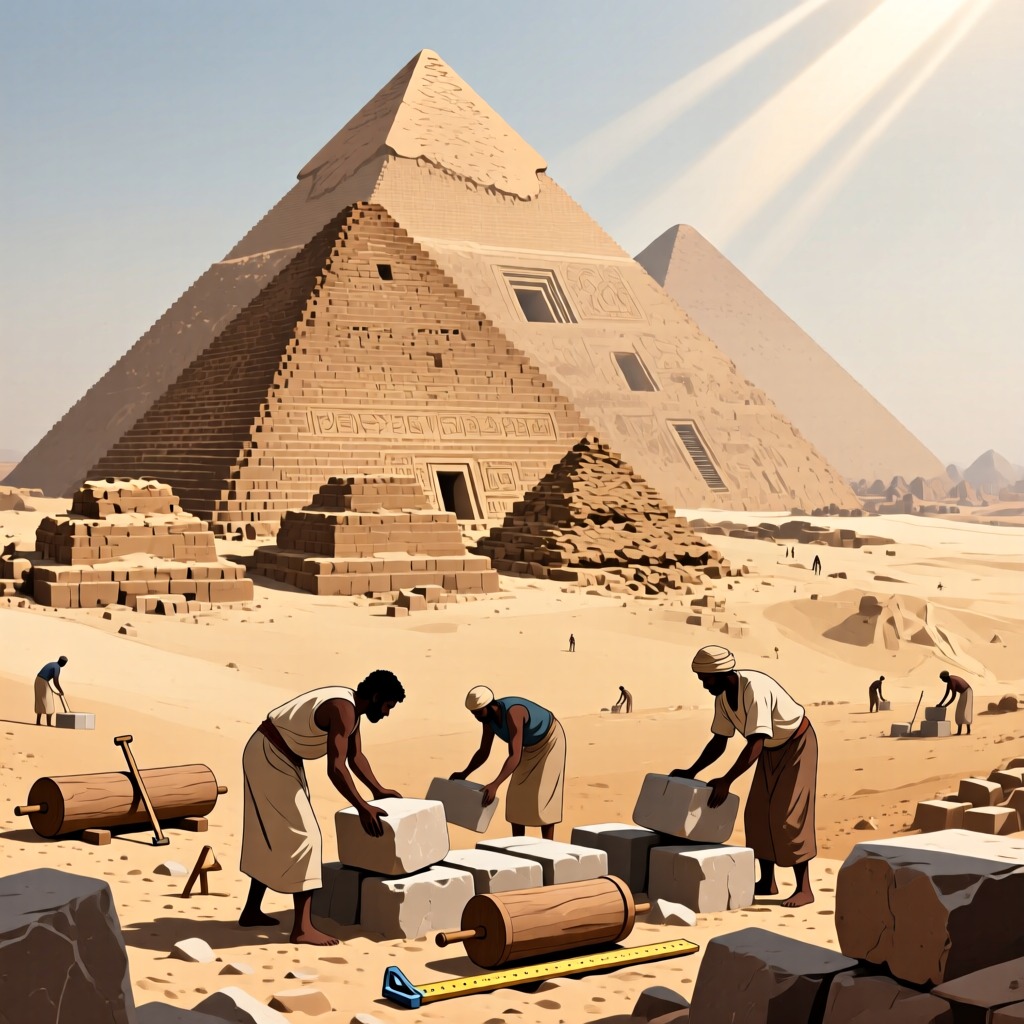

The Great Pyramid of Giza, a colossal structure standing on the Giza Plateau in Egypt, has towered there since around 2600 BC. After nearly 5000 years of weathering, it remains an awe-inspiring sight. It is the tallest of the Seven Wonders, reaching a height of approximately 146.5 meters, with each side of its base measuring 232 meters. Constructed from 2.3 million massive stones, each weighing an average of 2.5 tons, the stones fit together so tightly that not even a sharp blade can slip between them.
Not only is the Great Pyramid an architectural marvel, but it also symbolizes human ingenuity. Its internal structure is complex, resembling a maze, with ventilation shafts extending deep underground and smooth stone walls adorned with intricate carvings. However, how did the ancient Egyptians achieve this? What tools and techniques did they use? It's important to note that 4500 years ago, humanity had not yet mastered iron tools.
Building this pyramid required a massive workforce. Estimates suggest that Egypt's population would have needed to reach 50 million to provide the necessary food and labor for the project. Yet, around 3000 BC, the global population was only about 20 million, and the agricultural output of the Nile Valley could not support such a large construction crew.
Even more puzzling is how the ancient Egyptians transported the enormous stones. The traditional view holds that they used wooden rollers for transport, but this would require a vast number of trees, which were scarce along the Nile. Additionally, importing timber from distant lands would necessitate a large fleet of ships and a complex transportation process, which seems nearly unimaginable 4500 years ago.
The construction of the Great Pyramid presents not only a technical challenge but also a social and economic one. It consumed immense human and material resources and involved intricate organization and management. The existence of this pyramid remains one of the unsolved mysteries in human history.