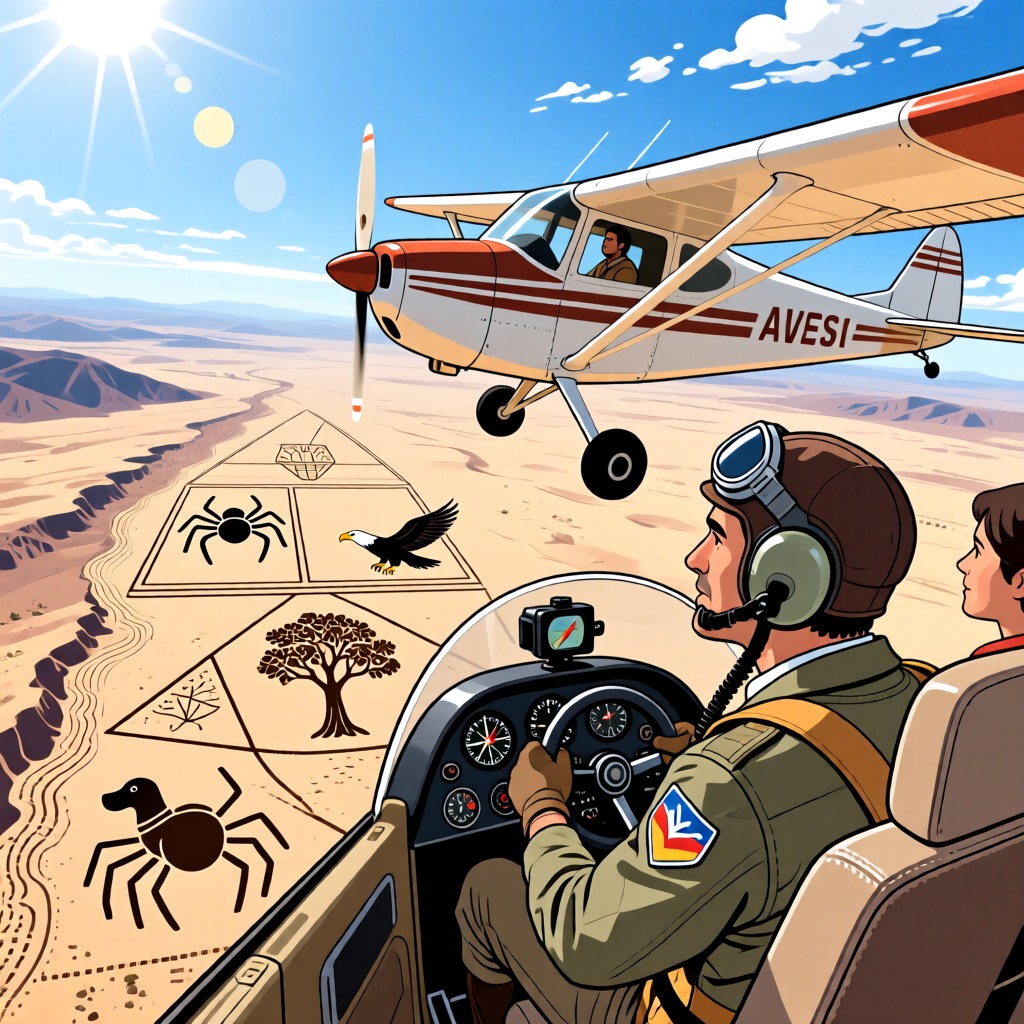
I sat in a plane soaring over these lines, exploring the mysteries behind them. Pilot Rodolfo Elias, a former jet fighter pilot, now flies an old Cessna, taking me on a journey from various heights to overlook the incredible geoglyphs of the Nazca Plain.
From a low altitude, the Amazon spider design seemed to come alive, with its legs outstretched. At 500 feet, we captured more details, including a dog, a tree, a condor, and many geometric shapes. As we flew up to 1500 feet, these massive designs transformed into scattered smaller patterns, surrounded by enormous geometric figures, resembling roads laid down by giants, crisscrossing the landscape.
As the ground receded, we climbed higher, gaining a broader perspective. Gazing down at the wedge-shaped grooves, I couldn't help but ponder that the creators of these lines must have had a special 'method.' Mathematician Maria Reiche once mentioned that these geometric figures resemble a kind of code, where the same letters are sometimes written in uppercase and sometimes in lowercase. These shapes exhibit similar forms and sizes, indicating a certain consistency.
It wasn't until the 20th century that humans learned to fly and the Nazca Lines began to be properly recognized. In the late 16th century, Spanish local administrative judge Luis de Monzón was the first to witness these mysterious 'desert markings' and recorded the peculiar legends associated with them. It wasn't until 1930, with the opening of air traffic in southern Peru, that people realized this barren land concealed the world's largest flat art pieces.
Rodolfo piloted the Cessna, circling around the monkey design on the ground. This large and intricate monkey figure is composed of a series of geometric shapes, evoking a strange yet captivating feeling. The monkey's body stretches 400 feet long and 300 feet wide, with winding lines that resemble a masterpiece of art.
Were the creators of these lines also mapmakers? Why are they referred to as the 'Viracocha people'?