
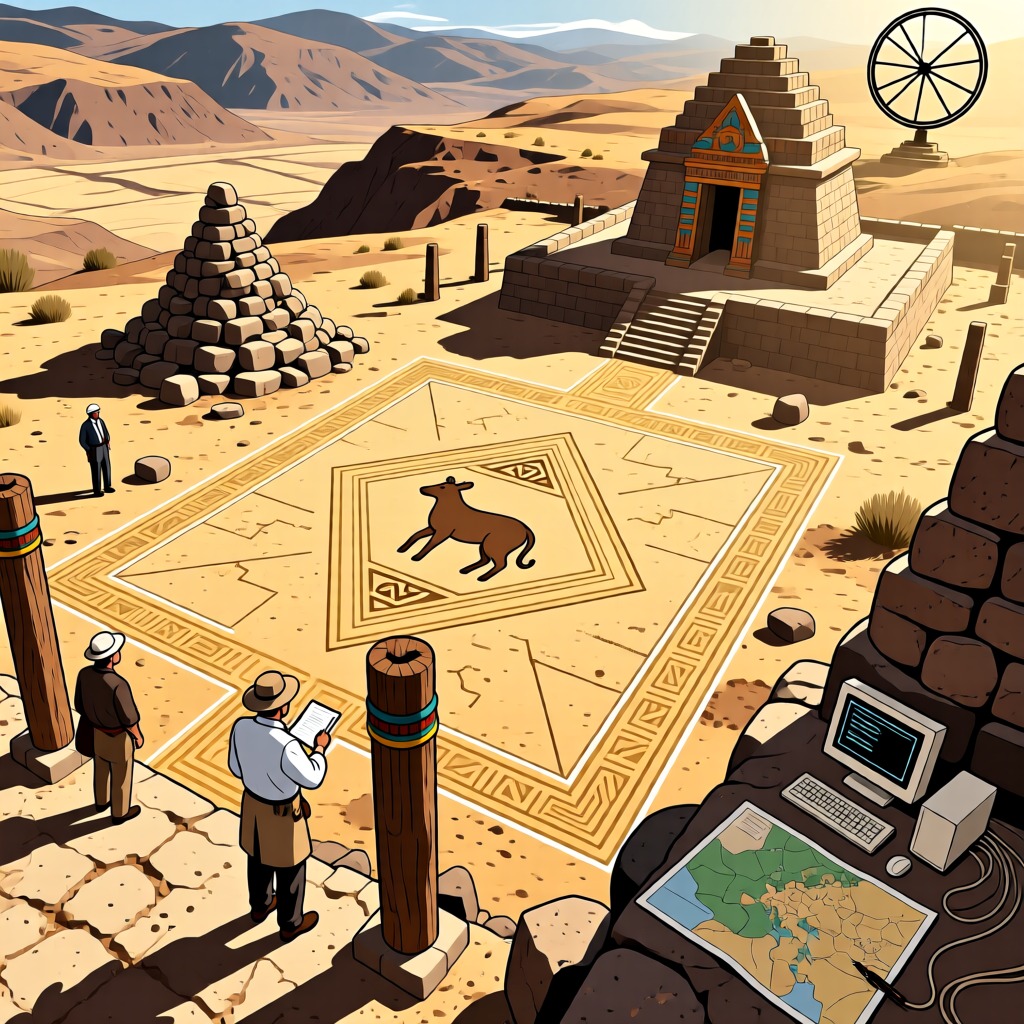

The true purpose of the Nazca Lines remains a subject of debate among scholars. Discovered in 1926 by Paul Kosok and his team in the arid highlands of southern Peru, these lines were formed by removing surface stones to reveal the underlying yellow earth. Initially, it was speculated that these lines served as roads, but it was later found that they are actually a series of complex geometric shapes and animal figures, ranging in length from 1.2 to 1.83 meters.
These lines are not only precise but their purpose is still a mystery. In 1941, Kosok suggested that these lines might have been used for astronomical observations. Further research by Maria Reiche proposed that the lines point to major constellations or the sun, possibly for calendar calculations. However, Hawkins' studies did not fully unravel the mystery. In 1977, researcher Tony Morrison joined the investigation and learned from the indigenous people of Cusco that these lines may represent sacred paths leading to shrines. Morrison found similar lines in Bolivia that connect mountaintop shrines, indicating a religious significance.
To this day, the true purpose of the Nazca Lines remains an unsolved enigma. They are currently protected, allowing for future research to uncover more secrets.
