
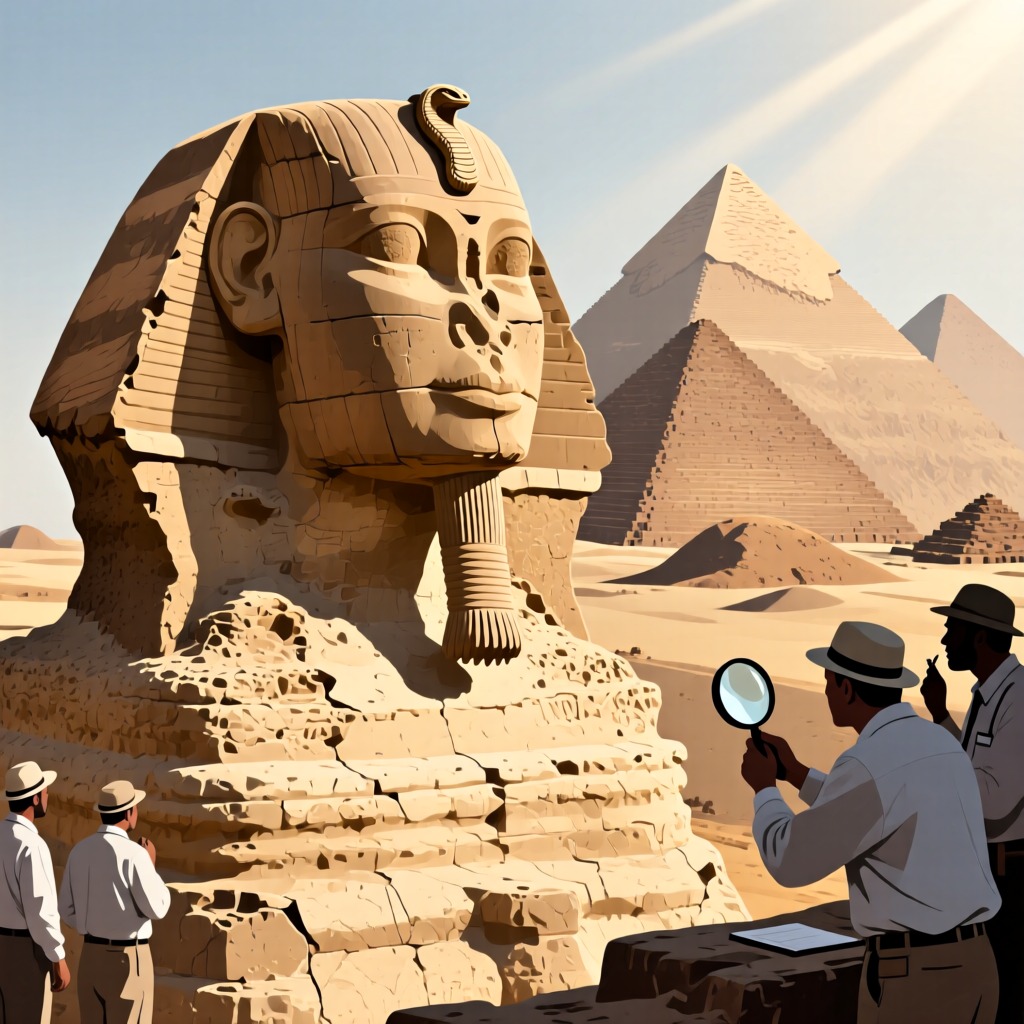

The Great Sphinx is a treasure of ancient Egyptian civilization, located in the Giza area, and is the largest sphinx in the world. The ancient Egyptians revered lions, seeing them as symbols of strength, which is why pharaohs often placed them beside tombs as guardians. The stone face of the Sphinx measures 5 meters in length, adorned with the nemes crown, and features a carving of the sacred cobra 'Uraeus' on its forehead, along with a long beard symbolizing royal authority. There is ongoing debate among scholars regarding its construction date; some believe it was built around 2500 BC during the reign of Pharaoh Khafre in the Fourth Dynasty of the Old Kingdom, while others suggest an even earlier date, possibly between 7000 and 5000 BC.
Scientists have conducted geological analyses and sonic tests, revealing that the 'tail' of the Sphinx was constructed approximately 500 years after the front, sparking extensive discussions about its actual construction timeline. Archaeologists argue that the ancient Egyptians could not have possessed such advanced building techniques, casting doubt on the geologists' conclusions. Some even speculate that the Sphinx was built by extraterrestrials, possibly as a navigational marker for astronauts, later discovered and utilized by pharaohs.
The Sphinx stands majestically, its solemn expression gazing into the distance. It has weathered many storms; during the Turkish attacks on Egypt, its nose and beard were used as targets, with the current nose and beard residing in the British Museum in London. The ongoing debates and speculations surrounding the Sphinx only add to its enigmatic allure, concealing a profound and mysterious history.
