
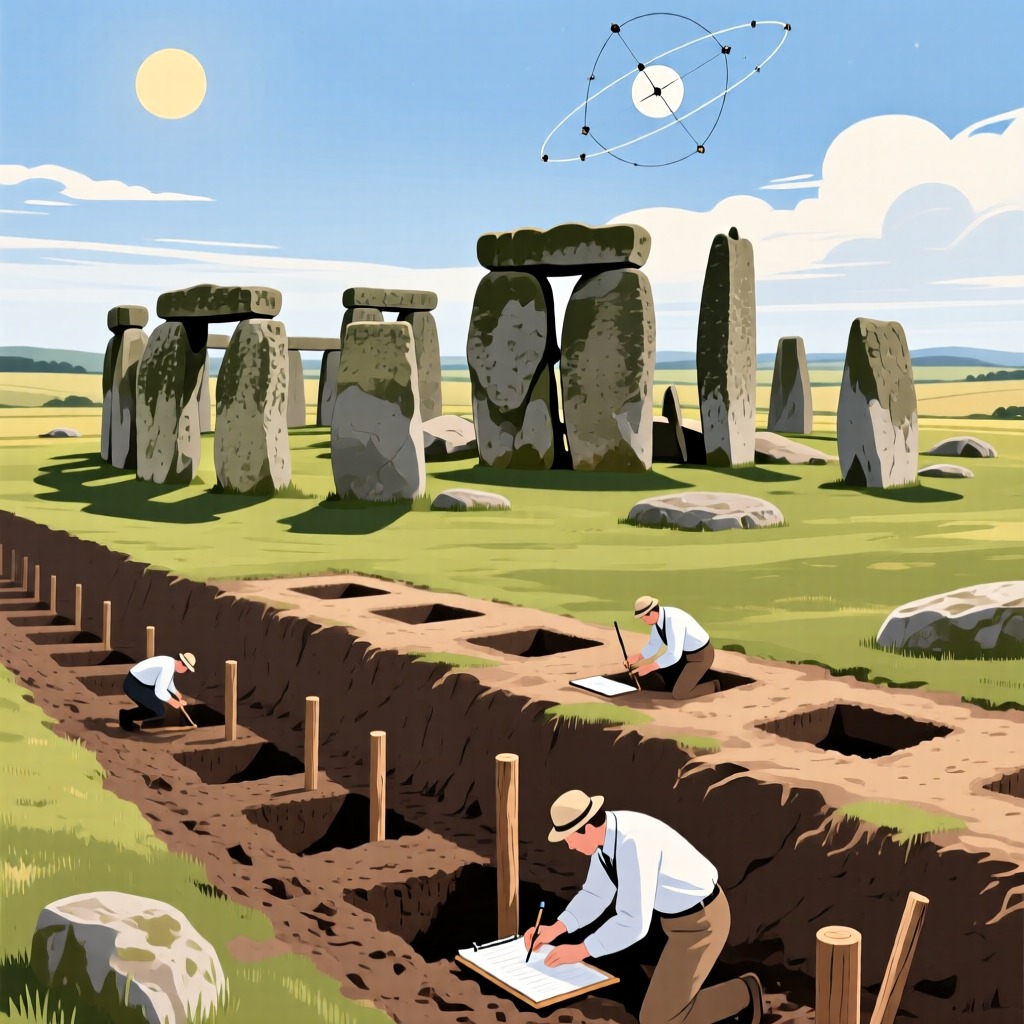

The mystery of Stonehenge: Is it an astronomical observatory or a religious site?
Located on the Salisbury Plain in southern England, Stonehenge is a world-famous monument consisting of a remarkable arrangement of massive stones. The purpose of Stonehenge has long been a subject of speculation, ranging from an astronomical observatory to a religious site, and even a place of execution, each theory shrouded in mystery.
The main structure of Stonehenge consists of enormous stone pillars arranged in a circular formation. Each pillar stands about 4 meters tall, 2 meters wide, 1 meter thick, and weighs approximately 25 tons, with the two heaviest pillars weighing around 50 tons. Some lintels are laid across the tops of the pillars, forming an arch-like structure. The main body of Stonehenge is composed of several complete concentric circles made of these gigantic stone pillars. Surrounding it is a ditch over 6 meters deep and about 21 meters wide, which outlines its shape. This ditch was dug from natural limestone soil, and the excavated earth was used to create a bank. Close to the inner side of the bank, 56 pits arranged at equal distances form another circle. These pits, discovered by archaeologist Aubrey in the 17th century, are known as the "Aubrey Holes."
The construction of Stonehenge is shrouded in mystery. Archaeologists have traced its construction back to around 2750 BC, possibly predating the oldest pyramids in Egypt. Estimates suggest that at least 30 million hours of labor would have been required to build Stonehenge, meaning at least 10,000 people would need to work continuously for a year.
Some believe that Stonehenge could have served as a place of execution. This theory gained traction after a human skull, dating back thousands of years, was excavated from the site. Modern analysis indicates that this skull belonged to a male who was likely decapitated by a sharp sword. A slight notch was found under the jaw, and a clear cut was discovered on the fourth cervical vertebra. Given that this burial was isolated, it is reasonable to believe that he did not die in battle but was executed by a sword. Several human remains have also been found in and around Stonehenge.
A popular theory suggests that Stonehenge was used for astronomical observations. As early as the 18th century, it was noted that the main axis of Stonehenge points towards the sunrise on the summer solstice, while the line connecting stones numbered 93 and 94 points towards the sunset on the winter solstice. Additionally, the 56 pits surrounding the site contained numerous human skulls, ashes, bone needles, and flint. Hawkins theorized that ancient people used these pits to predict lunar eclipses.
Whether Stonehenge served as an astronomical observatory, a site for religious activities, or a combination of both remains a topic of debate. Stonehenge acts like a powerful magnet, drawing people's attention. Perhaps it is a significant puzzle intentionally left by our ancient ancestors for future generations to solve.