
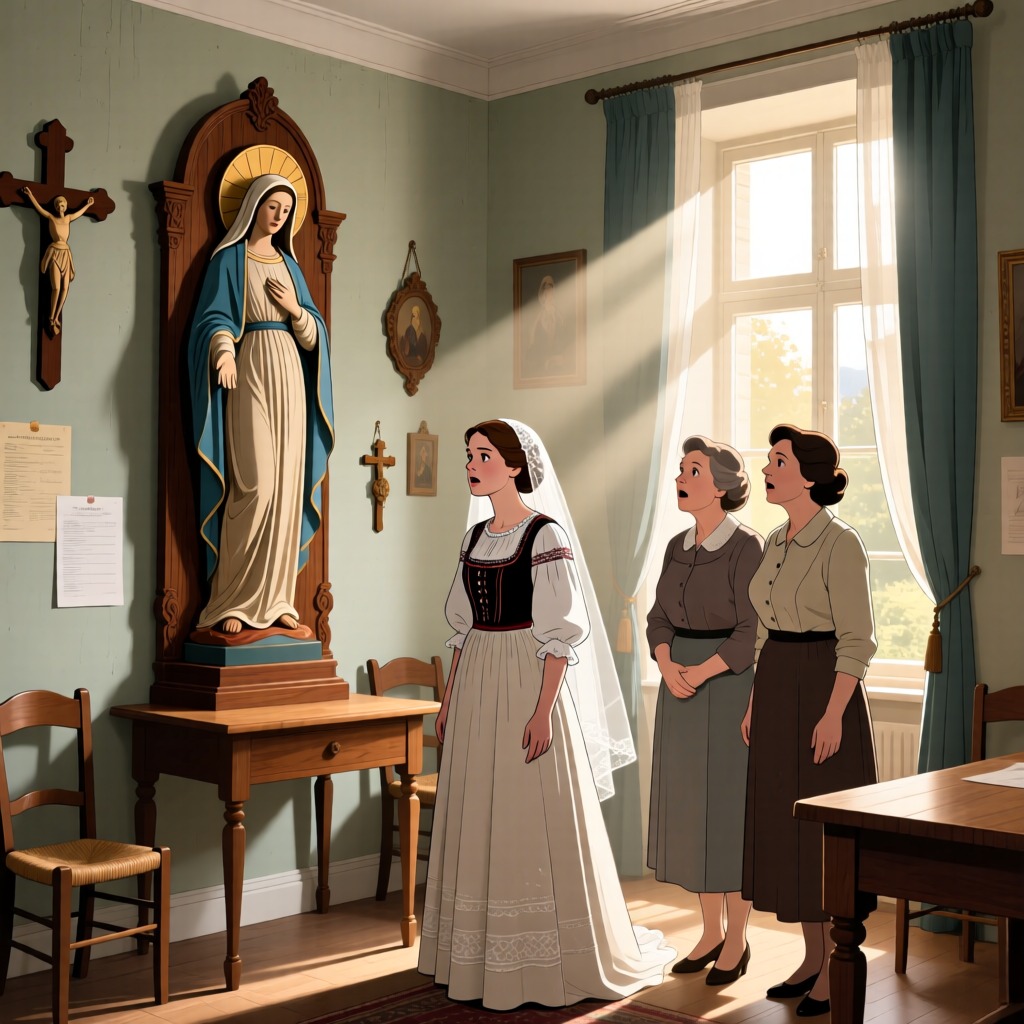

In 1953, a bride named Antoinette from La Nussau, France, received a statue of the Virgin Mary as a wedding gift. Shortly after her marriage, Antoinette became pregnant and began to suffer from severe headaches and intermittent blindness. One day, during an episode, she saw tears streaming from the statue's eyes. This phenomenon caught the attention of those around her, including her mother and cousin. While some suspected that Antoinette's pain had caused a mental breakdown, the sight of the statue weeping garnered widespread interest.
For four consecutive days, large crowds flocked to Antoinette's apartment to witness this miracle. One visitor even removed the statue for a closer inspection, discovering that while the wall behind it was dry, the statue's eye sockets were filled with two glistening tears. When the statue was taken to the police station, the tears continued to flow, soaking the uniform of the officer who carried it. Tests revealed that the chemical composition of the tears was remarkably similar to that of human tears.
This miracle sparked even broader faith and attention. Many believed that by wiping their bodies with cloth soaked in the tears, they could heal their ailments. A 49-year-old man regained the use of his left arm, and an 18-year-old girl recovered her ability to speak. After a month of these miraculous occurrences, the small statue was transported by train to a church, where it was placed in a glass shrine for public veneration. Over the next five years, tens of thousands of pilgrims visited, including several bishops and cardinals. Many discarded crutches served as proof of the miracles brought about by the Virgin Mary's tears.