
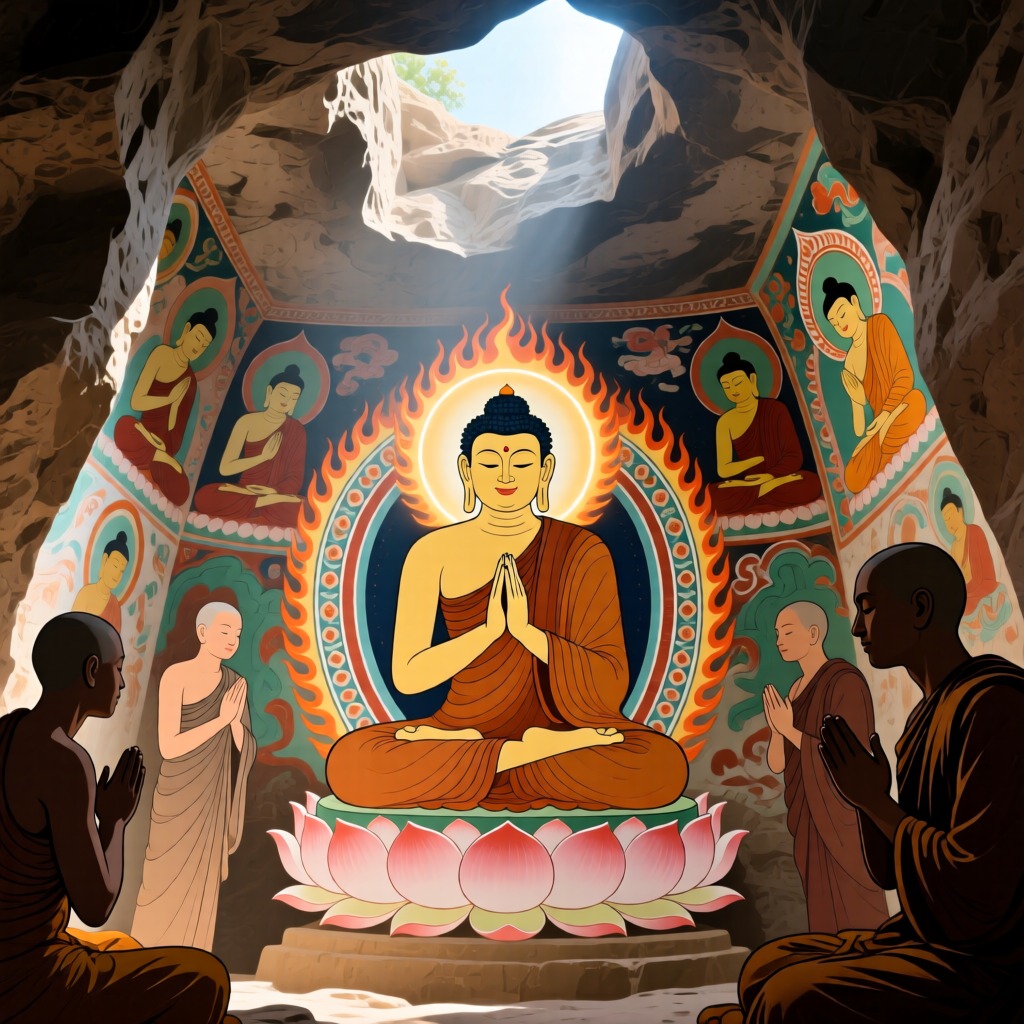

Buddhism promotes the concept of rebirth, emphasizing the accumulation of merit through virtuous actions, a notion that aligns with many near-death experiences (NDEs). The Ajanta Caves in central India showcase murals that illustrate this teaching of Buddhism.
The founder of Buddhism, Siddhartha Gautama, known as the Buddha, was born into the Kshatriya caste. He introduced the doctrine of 'anatta' or 'non-self,' viewing death as merely a stage in the cycle of life, contrasting with the monistic cosmic spirit of Hinduism. Despite engaging in debates with monks from Jainism and Brahmanism, his views on the soul were influenced by these religions.
In conversations with his followers, the Buddha frequently emphasized that the body, emotions, and consciousness are not part of the soul. He opposed the common fixation on the 'self' and suggested that the true essence of a person is beyond complete understanding. On questions such as 'Is the world eternal? Is the soul the same as the body?' the Buddha consistently adopted an agnostic stance, asserting that these inquiries do not contribute to the pursuit of wisdom.
Buddhism views death as an integral part of the cycle of life until one is liberated from this cycle, achieving the bliss of Nirvana. It is the first widely spread mass religion, influencing various regions across Asia. The Tibetan perspective on death is profound and relaxed; they believe that what we call birth is merely the opposite of death. Tibetan Buddhism posits that life consists of a series of continuous states of consciousness, including consciousness at birth, awareness of death, and the bardo state. Death does not signify the end of life but rather the beginning of the soul's transition into another form of existence.
