
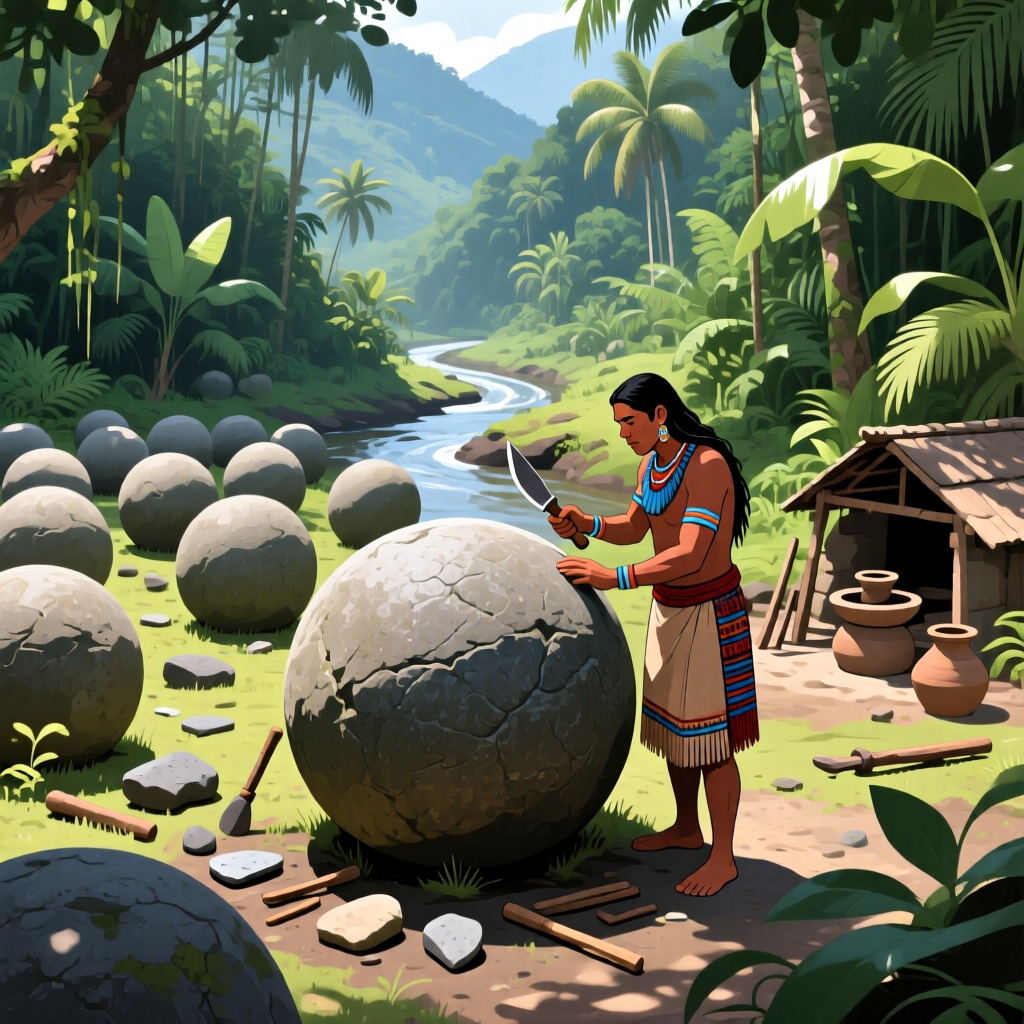

Located in the southern part of Central America, Costa Rica is a beautiful and fertile tropical country that was once home to over 30,000 Indigenous people. In the late 1930s, George C. Tait, a boundary surveyor for the United Fruit Company, stumbled upon a mysterious group of stone balls while exploring banana plantations. These stone spheres vary in size, with the largest measuring several meters in diameter, and their craftsmanship is astonishing.
In the Diquís region, archaeologists discovered 45 stone balls arranged in no particular order; some are in straight lines while others form gentle arcs. Scientists have found that the curvature of these stone balls' surfaces is almost perfectly uniform, making them ideal spheres. However, their purpose remains a mystery. Some believe they may symbolize the sun and moon flanking a burial site, or serve as totem markers, while others jokingly suggest they could be giant toys for giants.
Adding to the confusion, the granite used to create these stone balls has no known local source, and no trace of the original creators has been found. This has sparked a series of speculations about their background: Who made these massive stone spheres, and when? How were they transported to this location? What tools were used to create them?
After thorough investigations, archaeologists confirmed that the diameter of these stone balls has minimal variance, with accuracy approaching true spherical perfection. The craftsmen who made these spheres must have possessed extensive geometric knowledge and exceptional carving skills. This undoubtedly represents a monumental undertaking, requiring incredible effort from quarrying and cutting to polishing. Some legends mention that Costa Rican Indigenous people were visited by extraterrestrials, and whether these stone balls are related to such visits remains an unsolved mystery.