
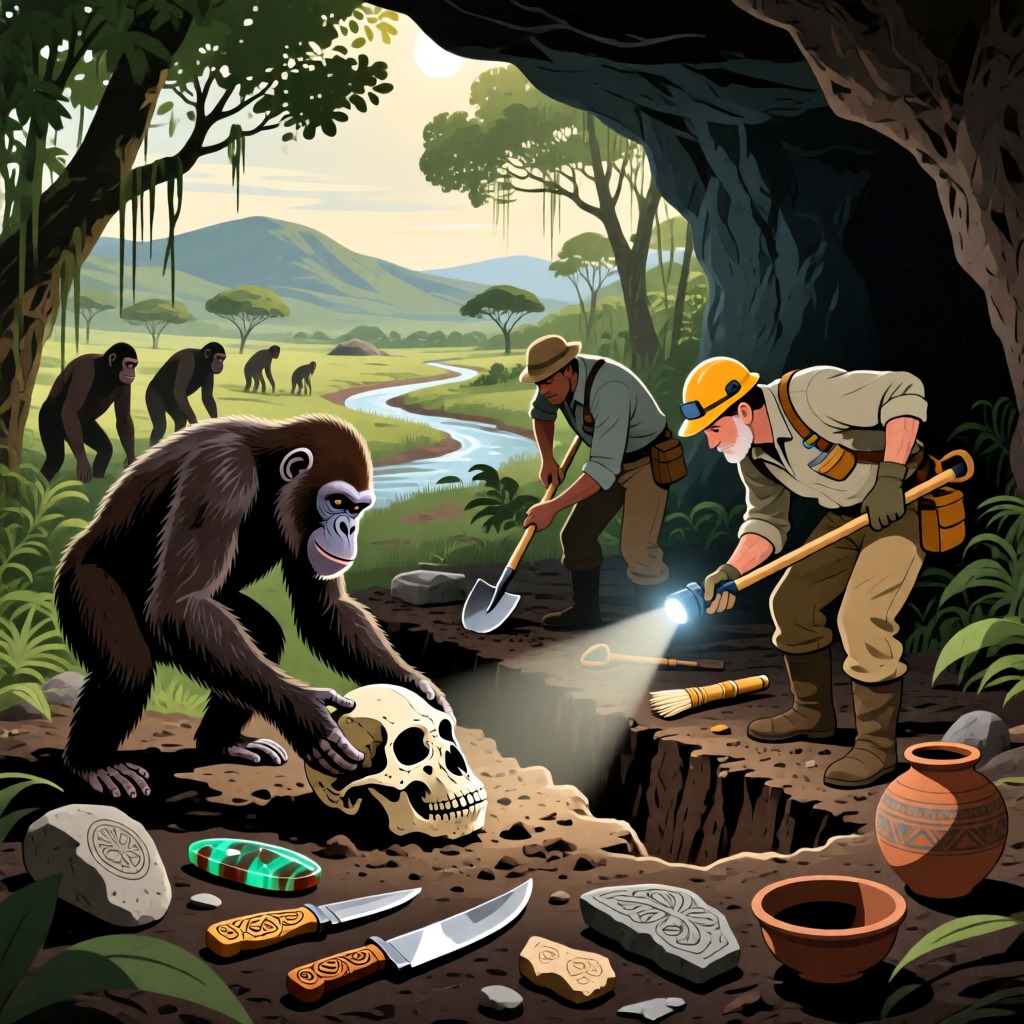

In the deep jungles of Africa, a group of primates is busy foraging for fruit. Suddenly, a shocking discovery changes the anthropological understanding of human origins. Over the past two decades, a series of astonishing archaeological finds have shaken traditional views on human evolution.
In 1979, an American spy satellite captured a brief explosion in the waters off southwestern Africa, suspected to be a nuclear explosion. However, this area had never conducted nuclear tests, and the weather conditions at the time did not support the formation of cumulonimbus clouds. This mysterious nuclear explosion remains an unsolved enigma to this day.
Meanwhile, a series of archaeological discoveries on the African continent reveal another side to human origins. In 1979, archaeologists uncovered a 3.75-million-year-old tooth and jawbone in Tanzania, suggesting that the ancestors of humans may have existed much earlier than previously thought. Subsequently, the discovery of a skeleton named "Lucy" in Ethiopia further filled in the gaps in the history of human evolution.
These findings not only challenge traditional evolutionary theories but also reveal the intelligence and level of civilization of early humans. For instance, in caves along the southern African border, archaeologists discovered artifacts dating back 50,000 years, including finely crafted agate knives and other tools, indicating that early humans possessed highly developed intelligence and creativity.
