
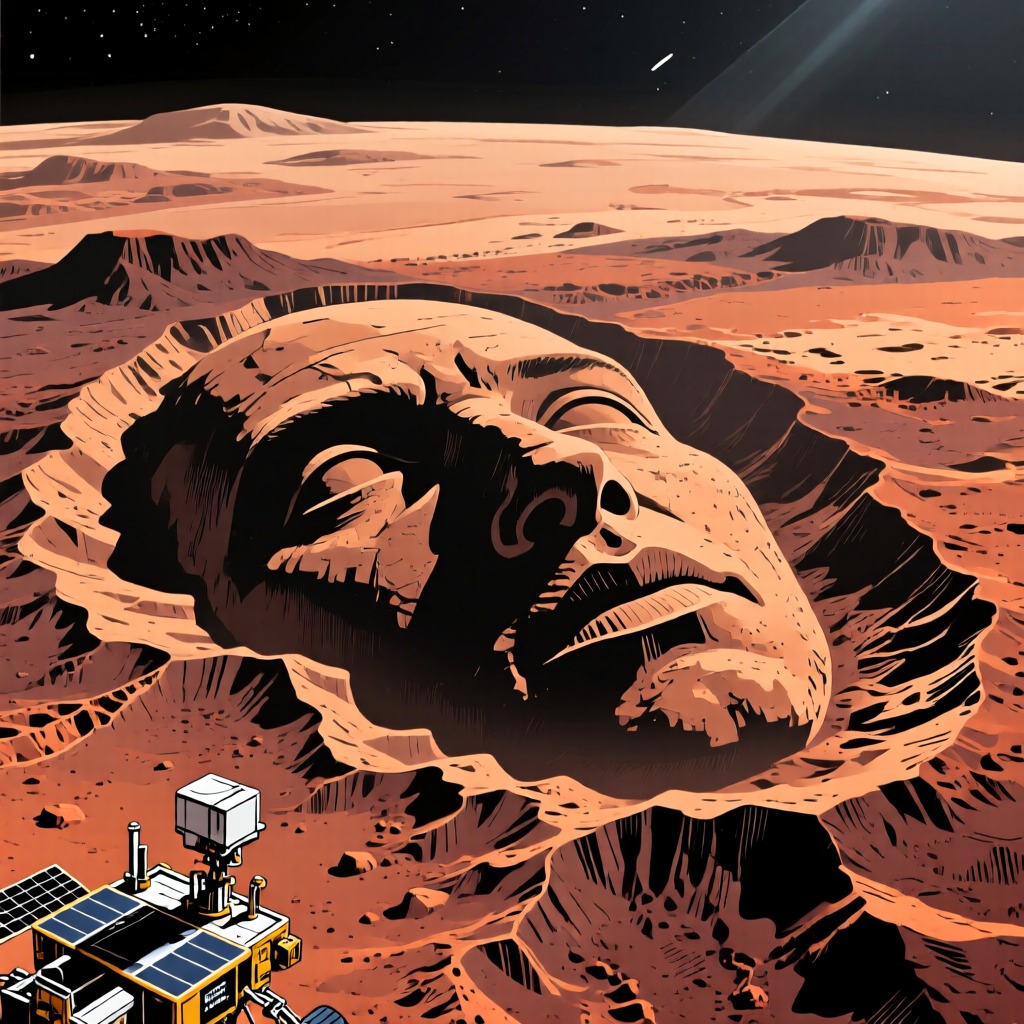

The mysterious 'Face' on Mars has long been an enigma that humanity cannot ignore in its quest to explore the universe. In 1976, the Viking 1 spacecraft captured images of this stunning landform in the Sidonia region, revealing shapes strikingly similar to human faces. Some even speculate that they could be massive monuments left by an ancient civilization.
At first glance, these formations appear to be ordinary hills, canyons, and cliffs. However, further research has shown that they exhibit a high degree of symmetry and complexity, raising doubts about their natural origins. Notably, in the image numbered 70A13, Vincent DiPietro discovered another face-like image, adding credibility to this phenomenon.
This face measures nearly 2.6 kilometers in length, about 1.9 kilometers in width, and stands approximately 800 meters tall, showcasing an astonishing level of complexity. While NASA initially attributed it to an optical illusion caused by light and shadow, later researchers have offered differing opinions. Image processing expert Dr. Mark Carlotto argues that the symmetry of this face is so pronounced that it rivals that of a naturally formed human face, making it unlikely to be a mere coincidence.
In the last year of his life, Carl Sagan shared his perspective, suggesting that this structure might be the result of millions of years of geological processes. However, he also acknowledged that due to the lack of close-up observational data, it is challenging to definitively ascertain its true nature. Therefore, he called for future Mars exploration missions to approach these mysterious formations more closely, using higher resolution equipment for detailed observation.
