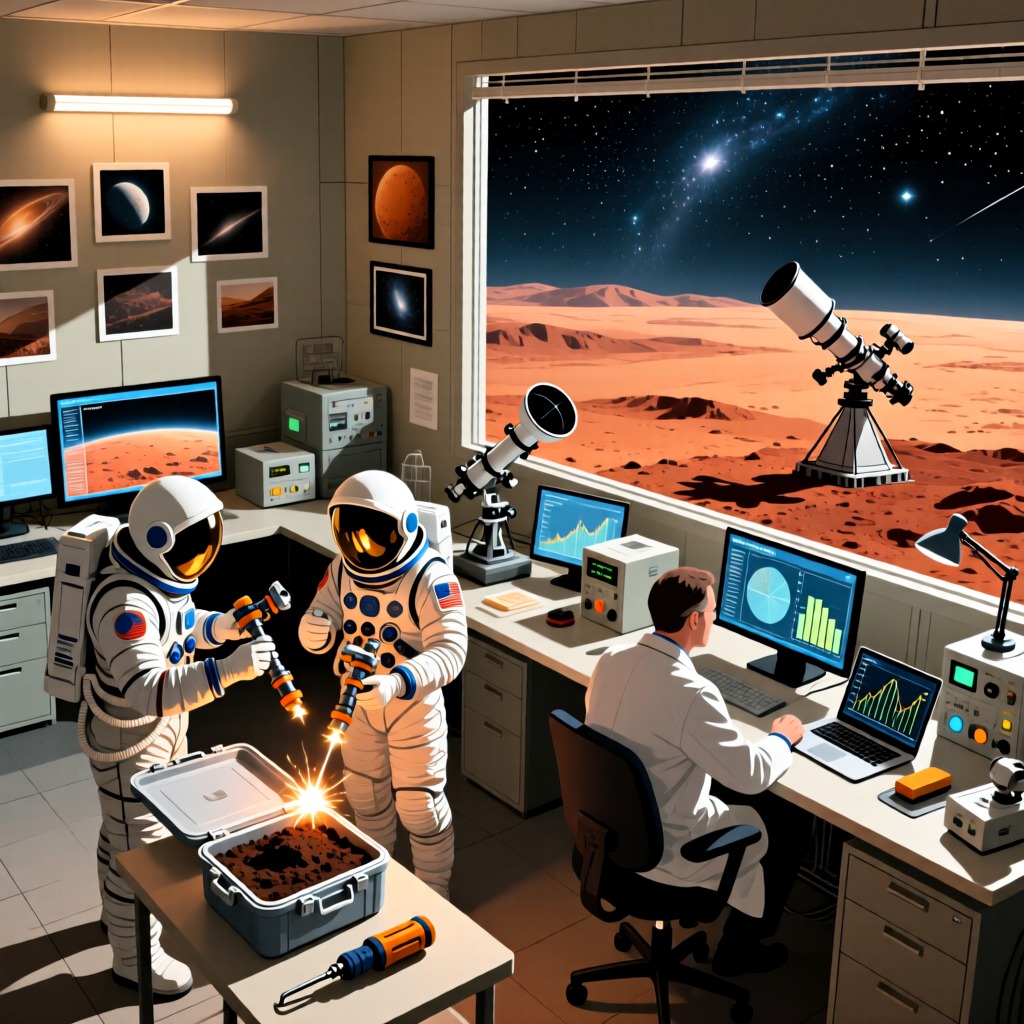

The mysteries of Mars and the birth of the universe have captivated scientists and enthusiasts alike. Mars features peculiar landscapes that prompt in-depth exploration. The stark differences between the southern and northern polar regions of Mars are astonishing; the southern region has small ravines, while the northern region boasts wide and deep chasms, reminiscent of Swiss cheese. These variations reveal significant climatic differences between the two poles of Mars, igniting scientists' enthusiasm for studying the planet's geological changes.
Simultaneously, the enigma of the universe's birth continues to draw human curiosity. How did the universe come into existence? What is its age? These questions have puzzled generations of scientists. Currently, there are three main hypotheses regarding the universe's origin: the eternal universe theory, the layered universe theory, and the Big Bang theory. The Big Bang theory posits that the universe originated from a massive explosion, subsequently expanding and evolving into the cosmos we observe today.
Scientists are utilizing advanced observational tools, such as the Hubble Space Telescope, to unravel these mysteries. However, the measurements of the Hubble constant have sparked widespread debate. The results derived from different measurement methods and devices vary significantly, complicating the question of the universe's age. With the introduction of new theories of cosmic origin, such as the metastable state universe theory, our understanding of the universe has become increasingly diverse and profound.