
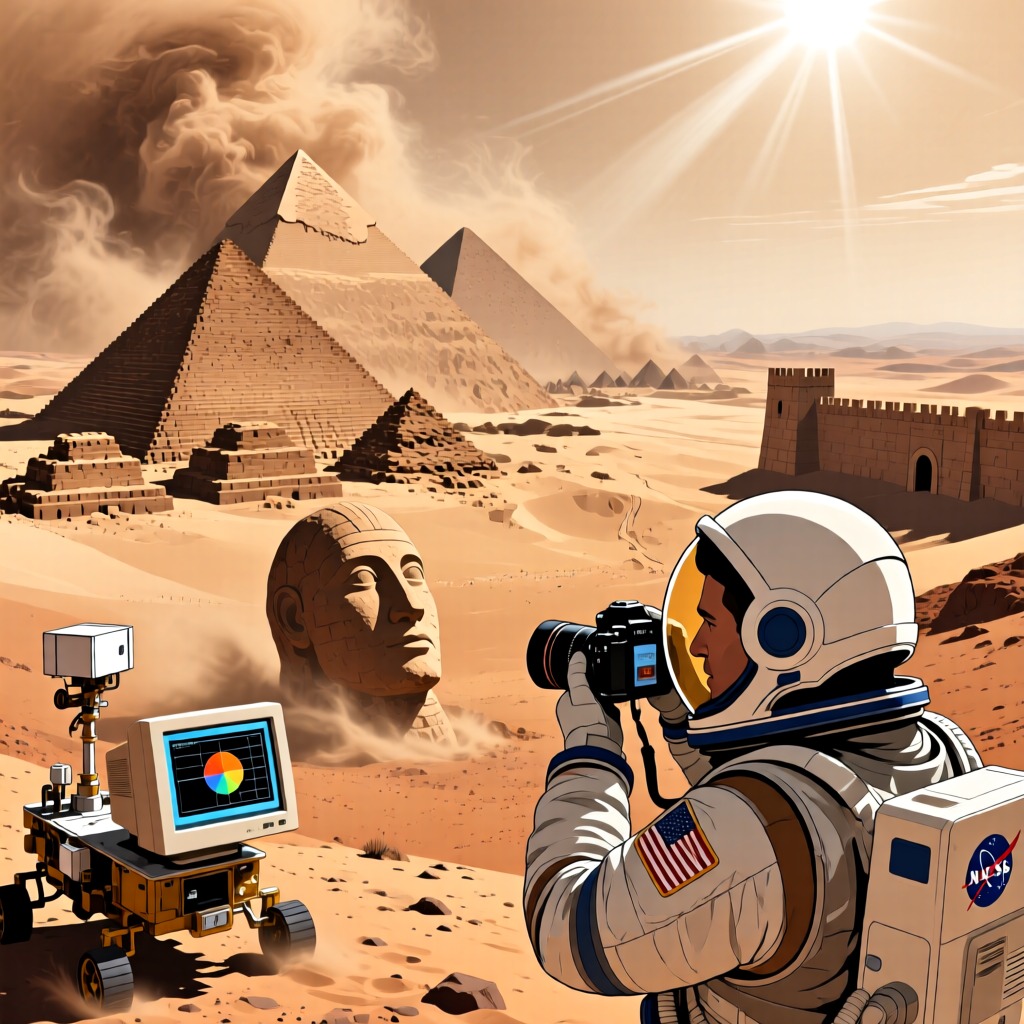

Modern explorations indicate that the red surface of Mars is due to the planet's atmosphere emitting infrared lasers, making Mars a massive gas laser. The Martian surface is rich in iron oxide, which gives it its reddish hue. Although Mars lacks the conditions necessary for life as we know it on Earth, photos taken by NASA's Viking 1 spacecraft in 1976 suggest that there may be remnants of a civilization, including the 'Face on Mars' and pyramid-like structures.
The image of the 'Face on Mars' captured by Viking 1 has sparked widespread discussion. In the photo, a massive structure gazes up at the sky, featuring distinctly carved features such as a nose, eyes, and mouth. After analysis using the latest technology, NASA technicians believe these features are artificially sculpted. Additionally, pyramid-like structures have been discovered, symmetrically arranged opposite the 'Face on Mars,' and are much larger than the pyramids of Egypt.
These findings have led to speculation about the origins of Martian civilization. Swiss astronomer Pasha proposed that the giant human-face structure on Mars serves as a warning, containing a television transmitter that reveals the tragedy of Martian civilization. This has ignited discussions about the potential reasons for the downfall of this civilization, with some suggesting that ecological disasters caused by the destruction of the atmospheric ozone layer may have played a role.
These discoveries not only unveil the mysterious architecture on Mars but also serve as a reminder for humanity to be vigilant against similar ecological disasters. NASA scientists warn that if humans do not take action to protect Earth's ecological environment, we may repeat the fate of Martian civilization.