
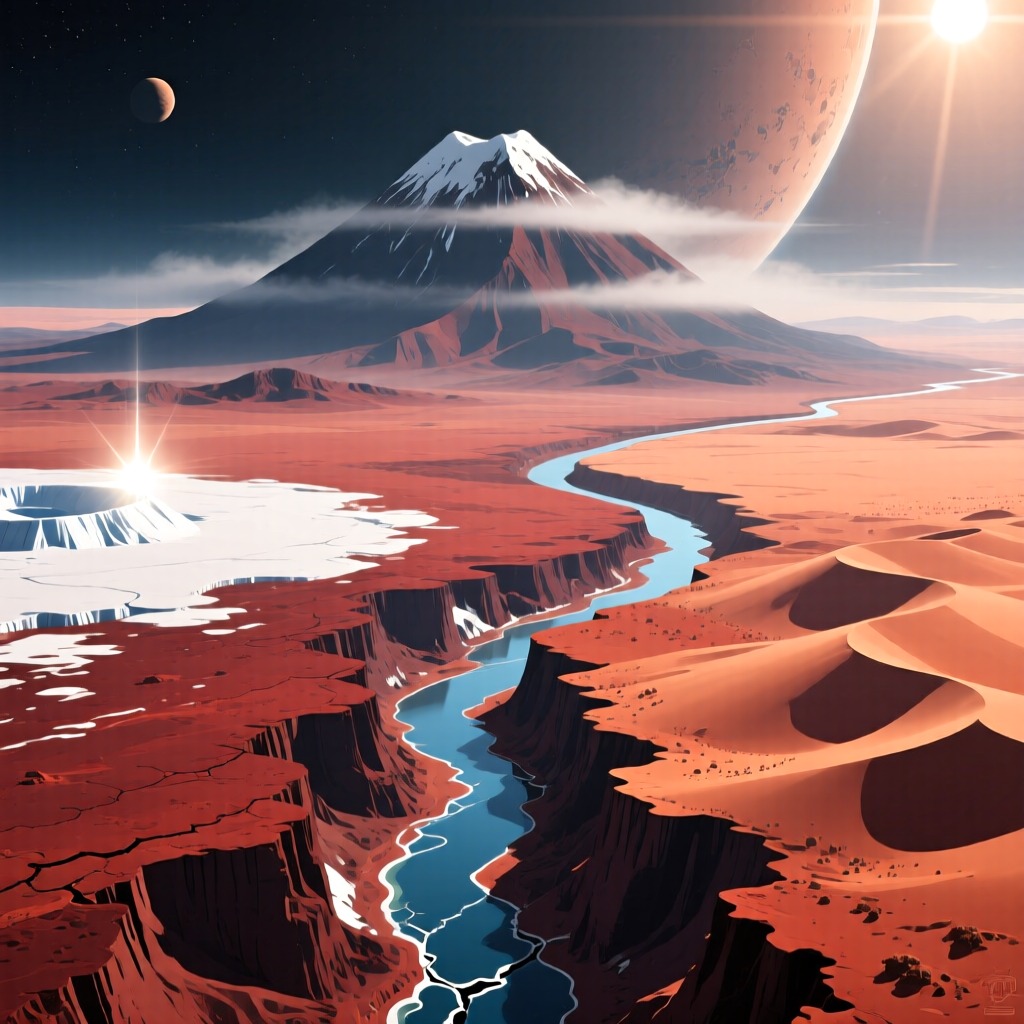

The unique landforms on Mars are a marvel of the universe. These features starkly contrast with Earth's terrain, showcasing the diversity and mystery of nature. Remote sensing images reveal that the Martian surface is dotted with massive volcanoes, deep canyons, vast plains, and complex impact craters. Not only do these landforms vary greatly in shape, but their formation processes are also intricate, leaving scientists still exploring their secrets.
Olympus Mons on Mars is the tallest known peak in the solar system, reaching a height of 21 kilometers, nearly three times taller than Mount Everest. Meanwhile, Valles Marineris is the longest canyon in the solar system, stretching 4,000 kilometers long, 600 kilometers wide, and over 10 kilometers deep, a scale that is truly astonishing. Additionally, the polar caps in Mars' northern and southern regions are also research hotspots, composed of dry ice and water ice, with seasonal changes causing their size and shape to fluctuate. What natural laws lie behind these phenomena?
There are still many unsolved mysteries on Mars, such as why there are extensive lava flows and why certain areas experience seasonal dust storms. These questions spark endless imagination about the red planet. Exploring the unique landforms of Mars is not only an appreciation of nature's beauty but also an adventure into the unknown, where each discovery could unveil a new chapter.