
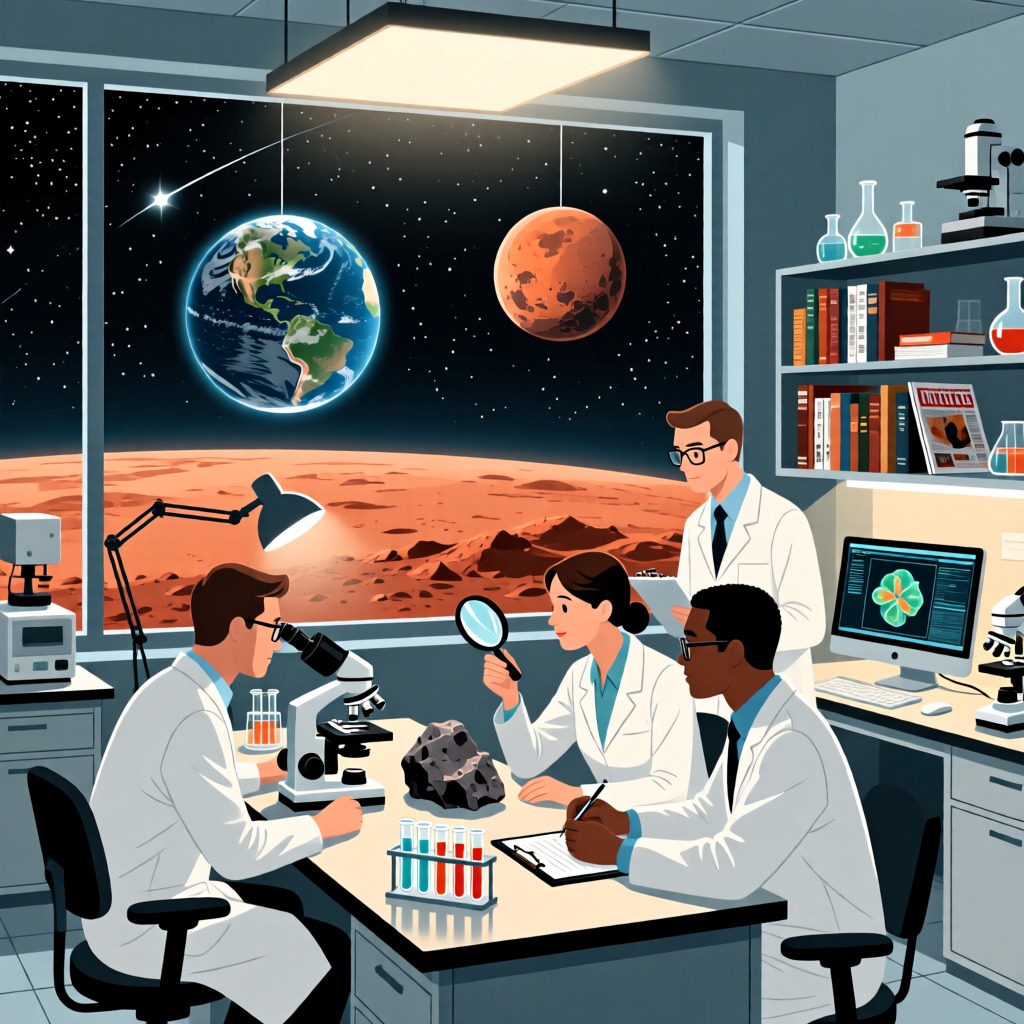

In early August this year, NASA announced the discovery of certain special organic materials in a meteorite believed to be from Mars and over 4 billion years old, suggesting that these organic compounds might be related to bacterial activity on Mars. Does this mean that single-celled life forms, like bacteria, existed on Mars 3.6 billion years ago? The reality is more complex. Many experts remain cautious about this claim and even question whether the meteorite truly originated from Mars.
Even if the meteorite is indeed from Mars, there is a lack of evidence to prove that the organic materials were produced by Martian bacteria. Interstellar molecules, including complex organic compounds like cyano-decapentyne, have already been found in the universe. Therefore, the idea that single-celled life once existed on Mars remains speculative rather than conclusive.
However, this discovery has sparked interest in extraterrestrial life. Although NASA emphasizes that there is no evidence of higher life forms on Mars, this has not dampened the enthusiasm for exploring the origins of life. If single-celled life did exist on Mars 3.6 billion years ago, it would bring us closer to unraveling the mystery of life's origins.
The origins of life on Earth are equally mysterious. Single-celled life was already widespread on Earth 3.6 billion years ago, but how non-living matter evolved into single-celled organisms remains an unsolved puzzle. American scientist Stanley Miller once simulated the process of life's origins in a laboratory, but later studies indicated that his experimental results were far from reality. Some experts have turned to the hypothesis of Swedish chemist Svante Arrhenius, which suggests that spores entered the atmosphere from space and proliferated in the oceans, ultimately giving rise to all life. Although this hypothesis was once considered far-fetched, it has now been supported by computer simulations. The notion that Mars may have harbored single-celled life provides a new perspective and encourages experts to delve deeper into this research.
