

What exactly does the universe look like? There is currently no definitive answer. Stephen Hawking's perspective is that the universe is finite yet unbounded, possessing more dimensions than Earth. Just as Earth, despite being finite, has no edges, the universe is similarly structured. How can we understand these additional dimensions? We can illustrate this with the example of a small ball. A three-dimensional being observing a small ball entering a hole would see it disappear; however, to a two-dimensional being, the ball still exists. In the same way, we find it challenging to comprehend a universe with more dimensions than our own.
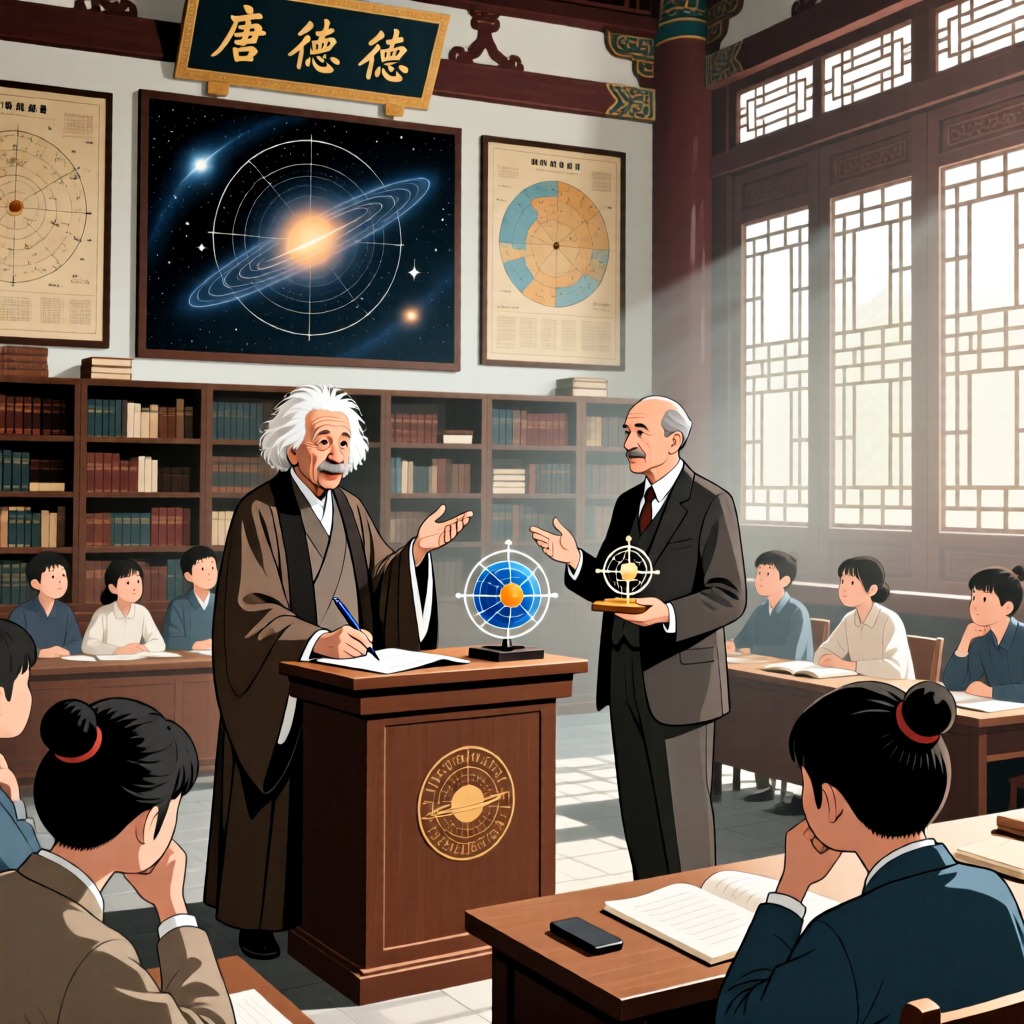
In 1915, Einstein published his theory of general relativity, and in 1917, he proposed a cosmological model based on this theory. In this model, the three-dimensional space of the universe is finite and unbounded, remaining unchanged over time. This means that being finite does not equate to having boundaries, similar to how a rectangular tabletop is finite and bounded, while the surface of a basketball is finite yet unbounded. According to cosmological principles, three-dimensional space is homogeneous and isotropic on a cosmic scale, and Einstein believed such space must be of constant curvature. He envisioned a static universe model but found that general relativity could not support this hypothesis. Consequently, he introduced the 'cosmological constant' to modify the field equations, resulting in a finite and unbounded static universe model.
Years later, Friedmann applied the field equations without the cosmological constant and derived a model of an expanding or pulsating universe. This model changes over time and can be categorized into three scenarios: negative curvature, zero curvature, and flat space, corresponding to an ever-expanding, stable, and pulsating universe, respectively. Friedmann's model overturned Einstein's static universe model, causing a sensation in the scientific community.