
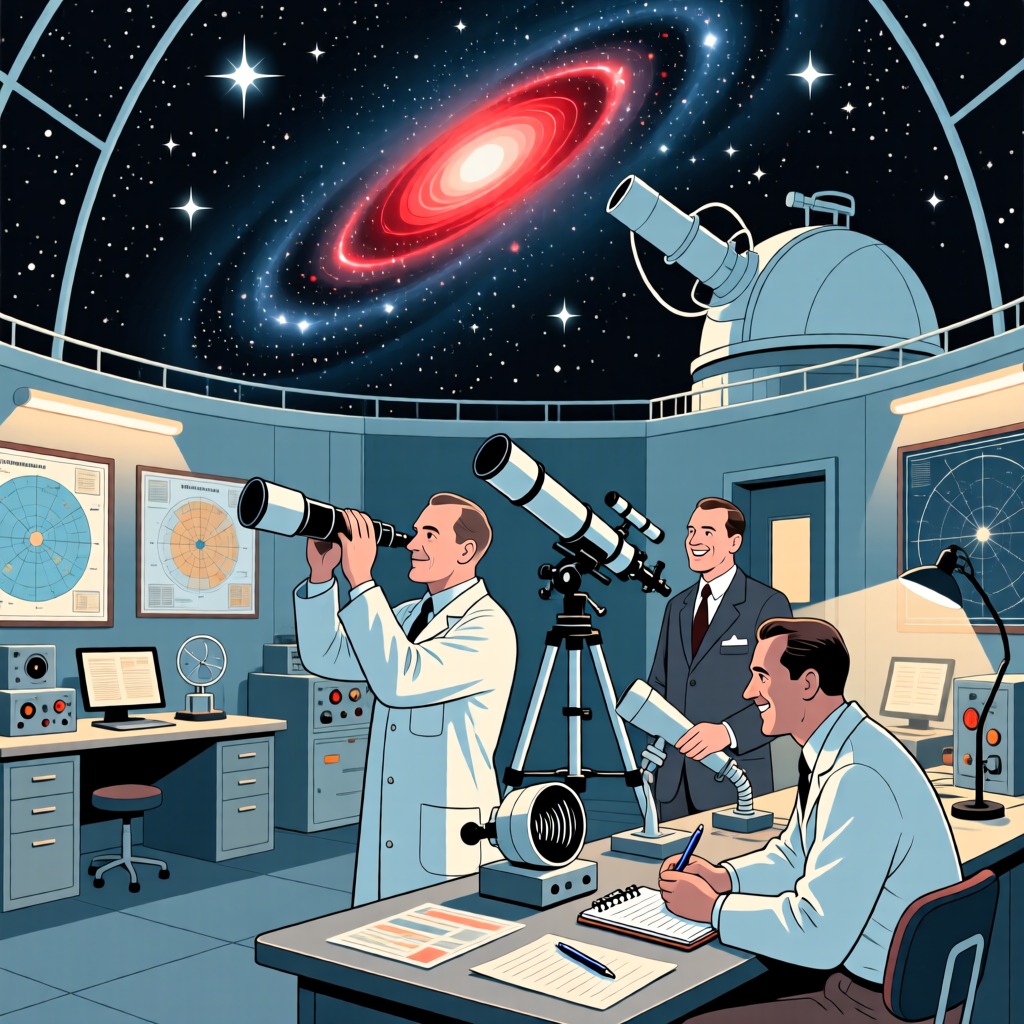

In the early 20th century, scientists discovered that the universe is expanding, a finding that originated from the study of the spectra of distant celestial bodies. American astronomer Edwin Hubble revealed the secret of this cosmic expansion by measuring the redshift phenomenon of galaxies. He found that most galaxies emit light that shifts towards the red end of the spectrum, indicating they are moving away from Earth at high speeds. The distance between these galaxies has been increasing over time, as if the universe experienced a massive explosion.
This discovery led scientists to propose the 'Big Bang' theory, which suggests that the universe originated from an extremely dense state and has been gradually expanding over time. This theory not only explains the motion of galaxies but also unveils the mysteries of the universe's origin. As the universe expands, its temperature decreases, ultimately forming the various galaxies and nebulae we see today. However, many mysteries about the state of the universe before the Big Bang remain unsolved by scientists.
In 1965, American scientists Arno Penzias and Robert Wilson detected cosmic background radiation using microwave detectors, which is the low-temperature electromagnetic radiation leftover from the Big Bang. This discovery confirmed the validity of the 'Big Bang' theory, and the two scientists were awarded the Nobel Prize in Physics in 1978. Meanwhile, the Russian-American physicist George Gamow, who proposed this theory, felt helpless due to his inability to answer questions about the universe before the Big Bang.
Additionally, some avant-garde scientists have suggested that the universe may not exist as a singular entity but could consist of multiple universes connected through extreme physical phenomena like black holes. While this idea is imaginative, it still requires more evidence to support it.