
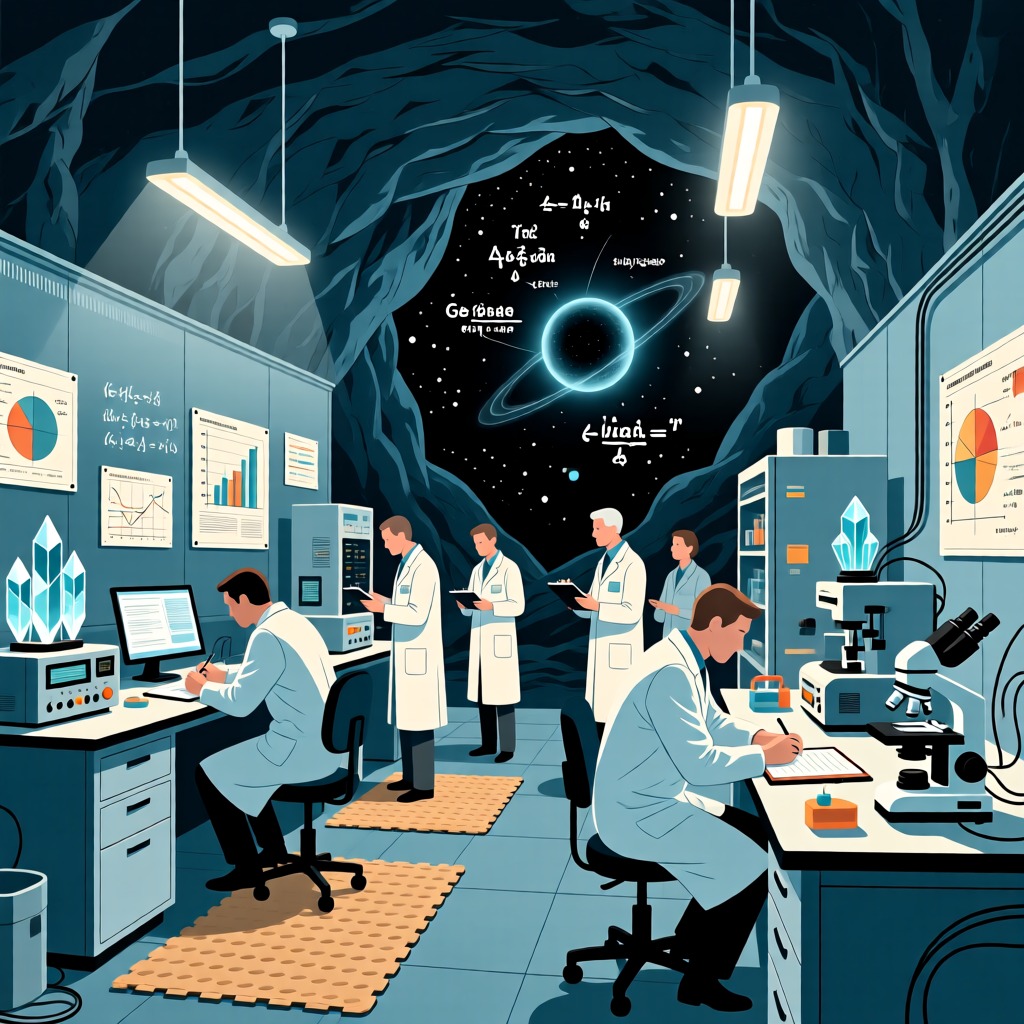

The mystery of dark matter in the universe
According to the Big Bang theory, before the universe was born, there was no time, space, matter, or energy. Approximately 15 billion years ago, a tiny point exploded, gradually expanding to form space and time, leading to the birth of the universe, which has since evolved. Galaxies, Earth, air, water, and life all formed within this ever-expanding spacetime.
Recent astronomical observations and studies of the expanding universe suggest that the density of the universe may consist of about 70% dark energy, 5% luminous and non-luminous objects, 5% hot dark matter, and 20% cold dark matter. This indicates that about 90% of the universe is made up of invisible dark matter, which may contain a type of unseen weakly interacting massive particle from the early universe—cold dark matter is crucial for supporting the theory of an expanding universe.
The search for dark matter and the exploration of its properties have become one of the focal points of high-energy physics research worldwide. The Institute of High Energy Physics of the Chinese Academy of Sciences is at the forefront of this field. In 1972, they observed a peculiar phenomenon where particles from cosmic rays with energy greater than 30 billion electron volts collided with particles in graphite, producing three charged particles. Analysis revealed that one particle was a negative meson, another was a proton, and the third was a charged particle with energy exceeding 4.3 billion electron volts and a lifetime longer than 0.046 nanoseconds. Many scientists believe that if this can be confirmed, it would certainly be a new particle beyond the Standard Model, potentially representing dark matter particles.
In 1979, scientists discovered that the temperature in the direction of the Andromeda background was higher than in other directions of the sky, indicating the presence of a massive unknown quality. According to Newton's law of universal gravitation, planets farther out in a galaxy should rotate more slowly around the galaxy's center. However, many galaxies have been observed where the outer planets rotate faster than those near the center. This suggests that, in addition to visible galaxies or galaxy clusters, there is a significant amount of dark matter hidden within, enveloping galaxies and galaxy clusters like a halo. So, what is this halo made of?
In the 1980s, some scientists in the United States and the Soviet Union proposed the "axion" model of dark matter. According to this model, in the beginning of chaos, the universe was like a thick soup of baryons and axions mixed together. Later, baryons gradually moved to the center of clumps due to radiative energy, resulting in ordinary luminous matter being surrounded by a halo of cold particles, forming galaxy-like celestial bodies. This model is elegantly simple but requires more experiments for validation.
Scientists believe that cold dark matter particles should possess a type of heavy, stable neutral particle that does not directly participate in electromagnetic interactions but can engage in weak interactions and gravitational interactions. This particle is certainly beyond the Standard Model, and if it can be directly observed in experiments, it would represent a significant breakthrough in exploring the structure and fundamental laws of the microscopic world of matter.