
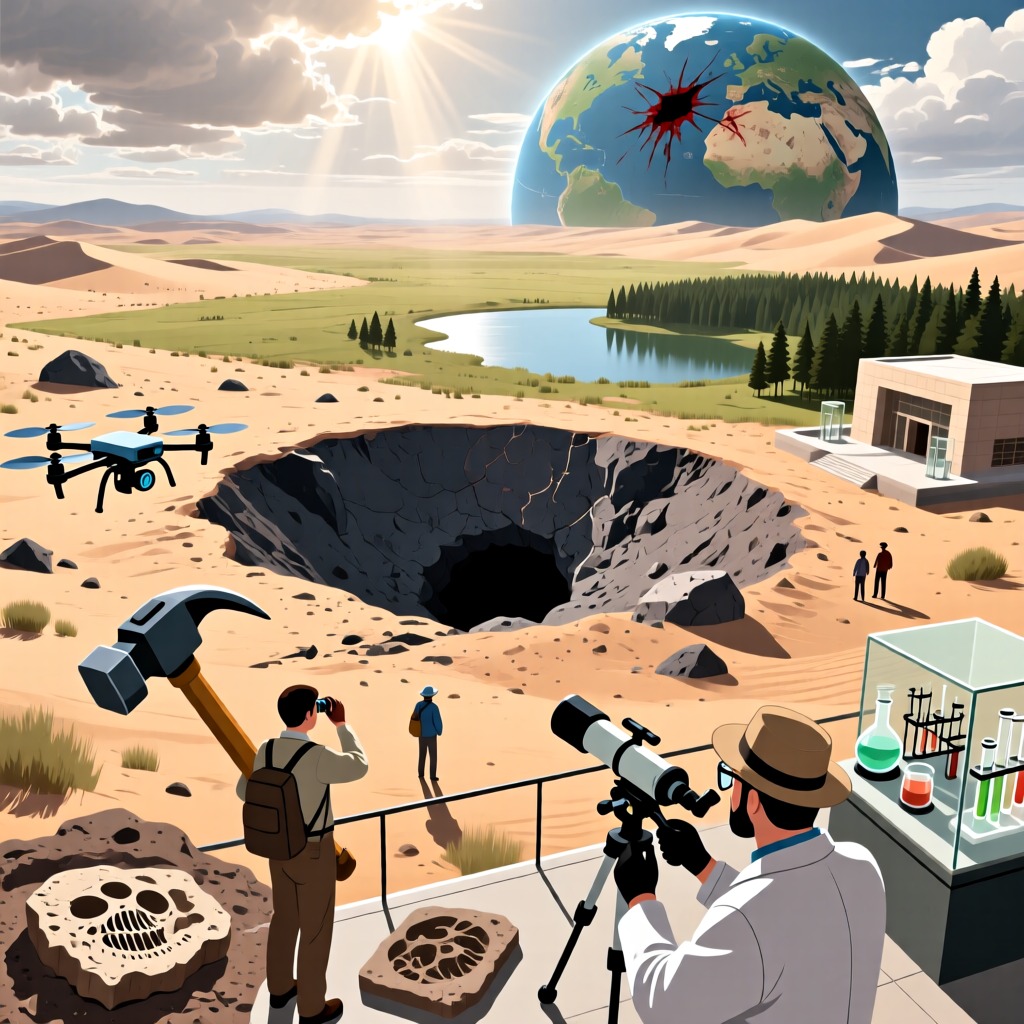

Despite most impact scars on Earth being smoothed over by natural forces or swallowed by the sea, scientists have still discovered over 120 surviving meteorite craters, with new ones appearing each year.
The Barringer Crater in Arizona, with a diameter of approximately 1,200 meters and a depth of about 180 meters, features edges that rise 30 to 40 meters high, making it a famous tourist attraction. It was first confirmed as a meteorite crater in 1905 by American engineer Daniel Barringer. The view inside the crater is spectacular, and visitors need to spend several hours walking around to complete a full circuit.
The Vredefort Dome in South Africa, with a diameter of 70 kilometers, was formed around 300 million years ago. Meanwhile, the Henbury meteorite craters in central Australia are hidden in an arid environment, preserving 13 craters, the largest of which is oval-shaped, measuring 220 meters long and 12 meters deep.
Lake Kali on Saaremaa Island in Estonia has a diameter of 110 meters and a depth of 22 meters, surrounded by six additional craters. China also has several meteorite craters, such as the 170-kilometer diameter crater in Duolun, Inner Mongolia; the 30-kilometer diameter crater in Shanghewan, Jilin; and the 3-kilometer diameter crater in Ruxing County, Guangzhou.
Scientists also speculate that many ocean basins on Earth, including the Pacific Ocean and the Gulf of Mexico, may have been formed by meteorite impacts. Although this theory has yet to be confirmed, meteorite impacts have indeed played a significant role in the history of Earth's evolution.