
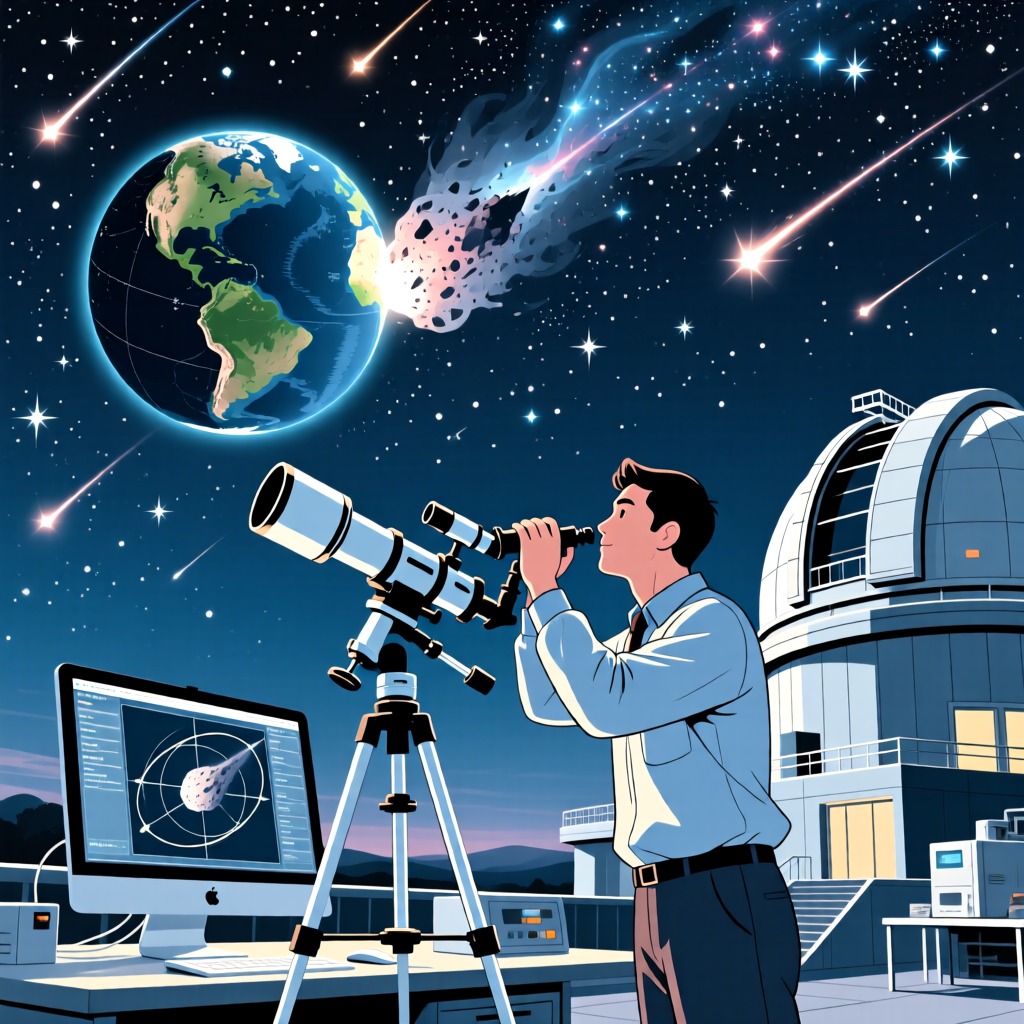

Will Earth kiss a comet? This question has intrigued many, as nearly every culture has its own legends about fiery skies and the earth engulfed in flames. A notable example is the Tunguska event of 1908, when a large fragment of a comet fell in the Siberian wilderness, causing a disaster. Such celestial impacts have altered the course of life on Earth multiple times, even influencing climate and leading to the decline of civilizations.
Today, astronomers have discovered numerous celestial bodies similar to large comet nuclei beyond our solar system, frequently traversing through it. Approximately one in every thousand comets is a massive, potentially dangerous body that could intrude into our solar system at any time. British researchers have used computer simulations to show that the gravitational pull of Jupiter and Saturn can draw comets into the solar system roughly every 200,000 years. These comets have unstable orbits and will eventually disintegrate under the sun's gravitational influence. In 1994, fragments of Comet Shoemaker-Levy 9 collided with Jupiter.
Astronomers predict that Earth may pass through a cloud of debris left by a comet again in the future, which could impact our climate. Scientists at Oxford University believe that the current ice age may have been caused by debris clouds from the last comet disintegration. They estimate that the next time Earth will cross such a debris cloud will be between the years 2800 and 3200.