
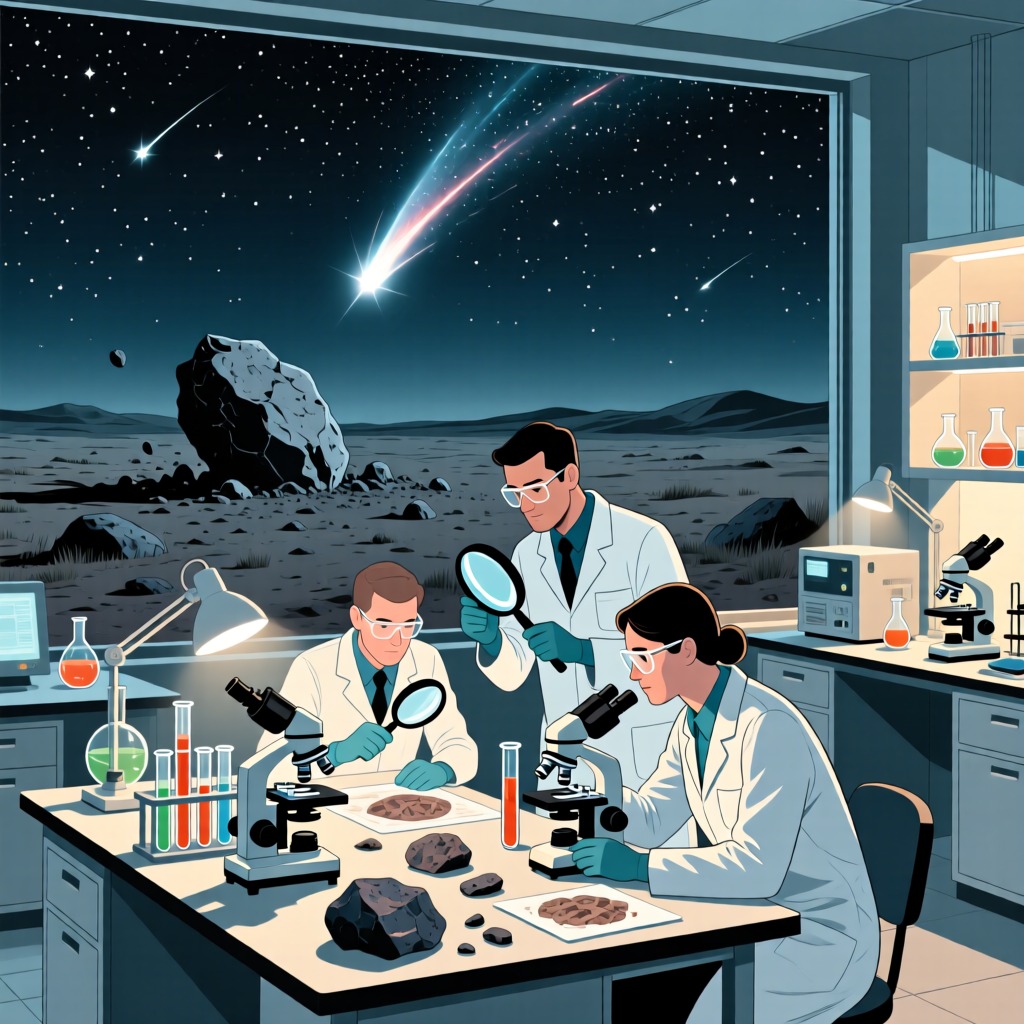

The discovery of organic compounds in meteorites has sparked speculation about the existence of extraterrestrial life. On one hand, some believe these compounds have a non-biological origin due to their higher concentrations of sulfur, nitrogen, and chlorine compared to similar compounds on Earth. On the other hand, proponents of a biological origin point out that certain meteorites contain oddly arranged elements resembling unicellular algae found on Earth. Even more mysterious, some meteorites have been found to contain optically active organic substances, which are rare in non-biological organic compounds.
However, interpretations of these findings are inconsistent. Some scientists suggest that the ordered molecules may have been influenced by contamination from Earth. Nevertheless, many believe that these meteorites indeed contain remnants of some form of extraterrestrial life. For instance, in a brass fragment that fell in Eaton, USA, in 1931, remnants resembling marine shells and trilobites were discovered. Additionally, in a "heavenly book" that landed near the Baltic Sea in Russia, scientists found plant matter of cosmic origin.
These meteorites not only serve as potential evidence of extraterrestrial life but may also act as a bridge for communication between Earth and extraterrestrial civilizations. Scientists speculate that long organic chain molecules found in certain carbonaceous chondrites might carry messages from distant civilizations. These discoveries not only challenge our understanding of the origins of life but also ignite curiosity about unknown intelligent life in the universe.
