
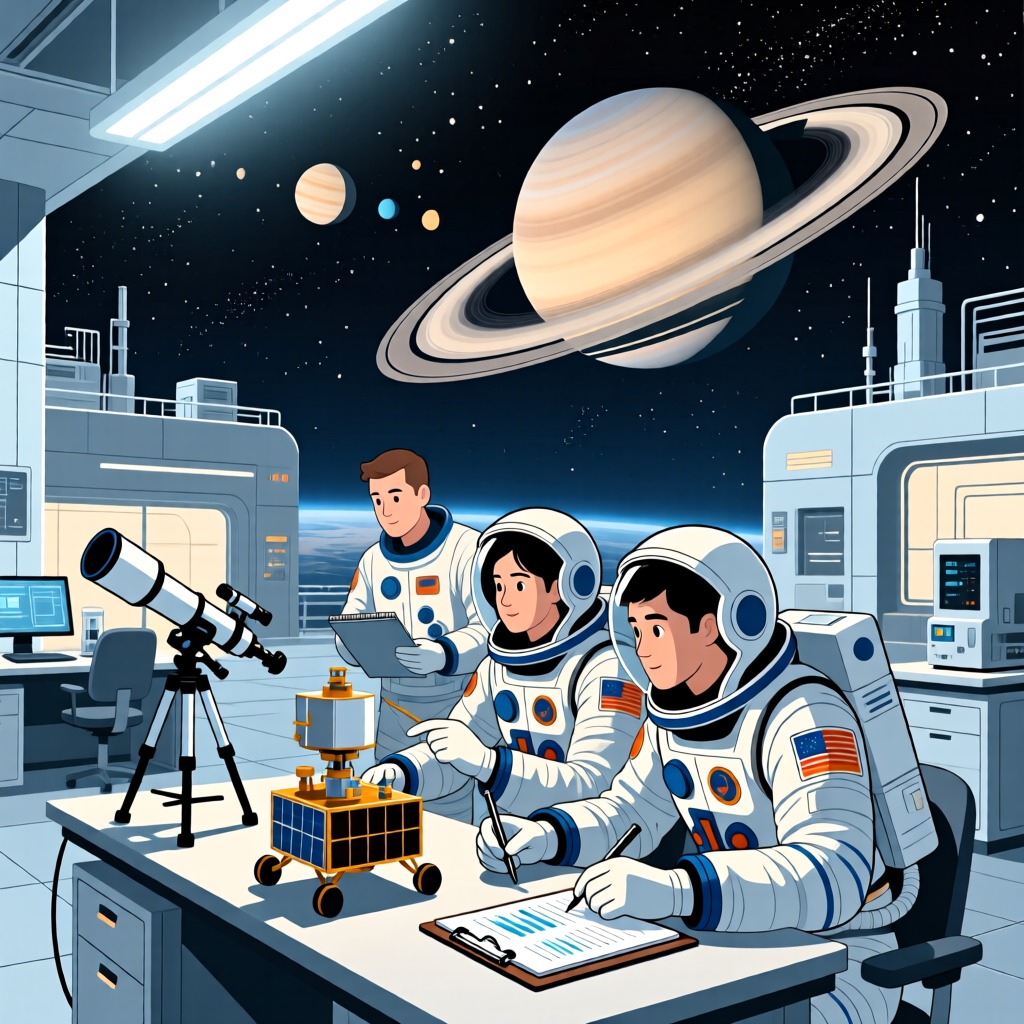

The family of Saturn's moons has rapidly expanded from 10 in the 1970s to 23, making it one of the most spectacular groups of satellites in the solar system. This change not only marks a new chapter in solar system exploration but also showcases the power of modern technology. From Pioneer 11 to Cassini, a series of space probes have fundamentally altered our understanding of Saturn and its moon system.
In 1973, Pioneer 11 first discovered Saturn's twelfth moon, marking the beginning of the expansion of the moon family. Subsequently, Voyager 1 and Voyager 2 discovered numerous new moons between 1979 and 1981, significantly increasing the number of Saturn's satellites. Cassini embarked on a long journey lasting seven years, planning to enter Saturn's orbit in 2004 for in-depth research. These probes not only increased the number of moons but also revealed many mysterious phenomena, such as the retrograde motion of moon Phoebe and the unique orbital patterns of moons like Janus and Epimetheus.
Today, the total number of known moons in the solar system has reached 66, with Saturn proudly holding 23 of them. Phoebe is the farthest moon, located 13 million kilometers from Saturn, while Methone is the closest, at just 137,000 kilometers. Moons like Prometheus and Pandora act as shepherds, positioned on either side of Saturn's F ring.
With advancements in technology, our understanding of Saturn and its moon system has deepened, yet many mysteries remain to be solved. In the future, more exploration missions will continue to unveil the secrets of Saturn's world.
