
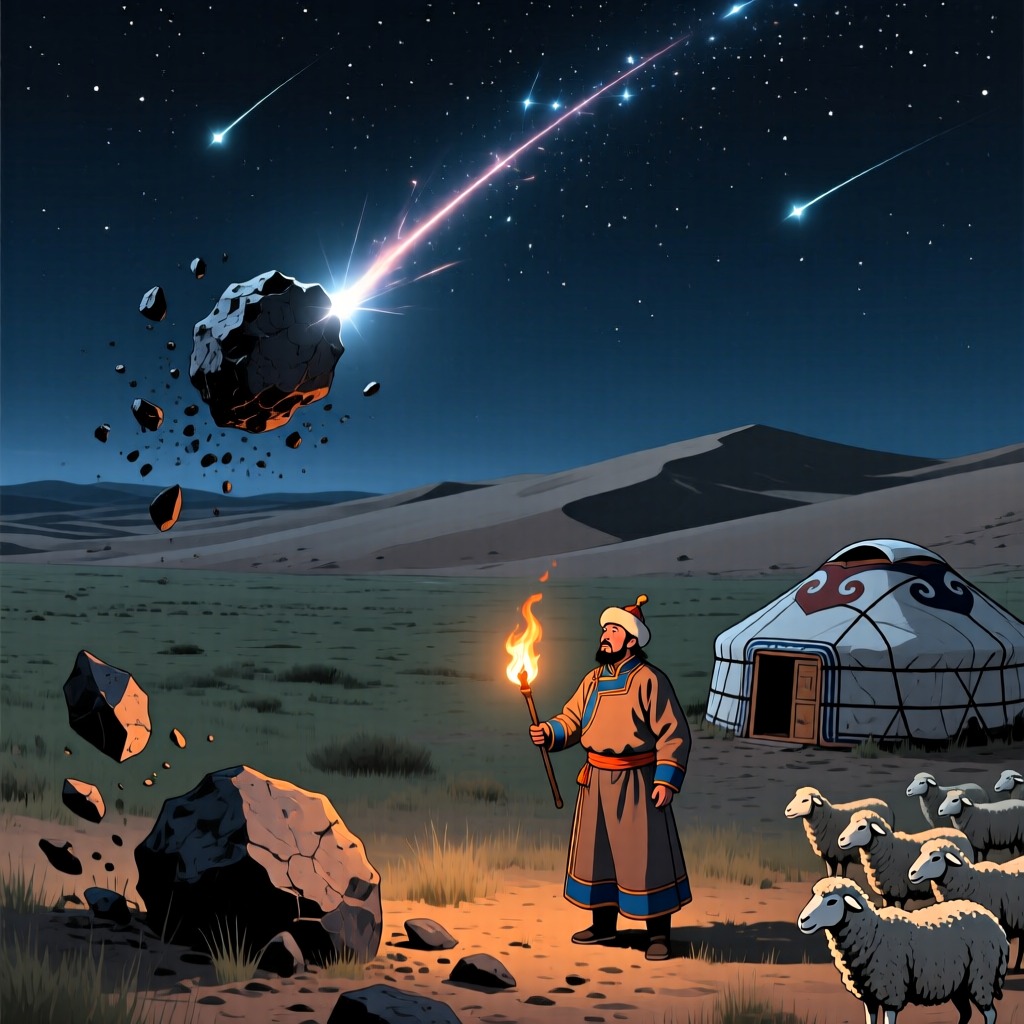

Meteorites not only carry the mysteries of nature but also bear witness to pivotal moments in human civilization. From ancient times to the modern era, these visitors from space occasionally descend to Earth, bringing either surprises or disasters.
The Hoba meteorite, weighing 60 tons, is one of the largest known iron meteorites and still lies quietly on the plains of Namibia, Africa. In contrast, the Jilin-1 meteorite from China seems much gentler; although it weighs 6.7 tons, it has been secured by a museum.
In 1971, a meteorite fell in Finland, containing extremely tiny cosmic diamonds, providing a new understanding of the relationship between Earth and the universe. In 1887, a meteorite containing a massive diamond fell by the banks of the Delga River, becoming a royal treasure.
Meteorites have also played the role of killers. In 1955, a woman in Alabama, USA, narrowly escaped being struck by a meteorite, while in 1847, a ship traveling from Japan to Italy met with disaster due to a meteorite, resulting in the deaths of two sailors. Even earlier, in 1639, a meteorite caused numerous casualties in Changshou County, Sichuan; in 1512, a meteorite ignited a fire in Fengcheng, Shandong, destroying over a thousand homes, and the following year, another meteorite fire left 20,000 households homeless.
These events remind us that the Earth is constantly being impacted by celestial bodies and may face even greater risks. History teaches us that meteorites are not merely beautiful astronomical phenomena; they can be harbingers of disaster. These stories and facts deepen our understanding of the power of nature.