
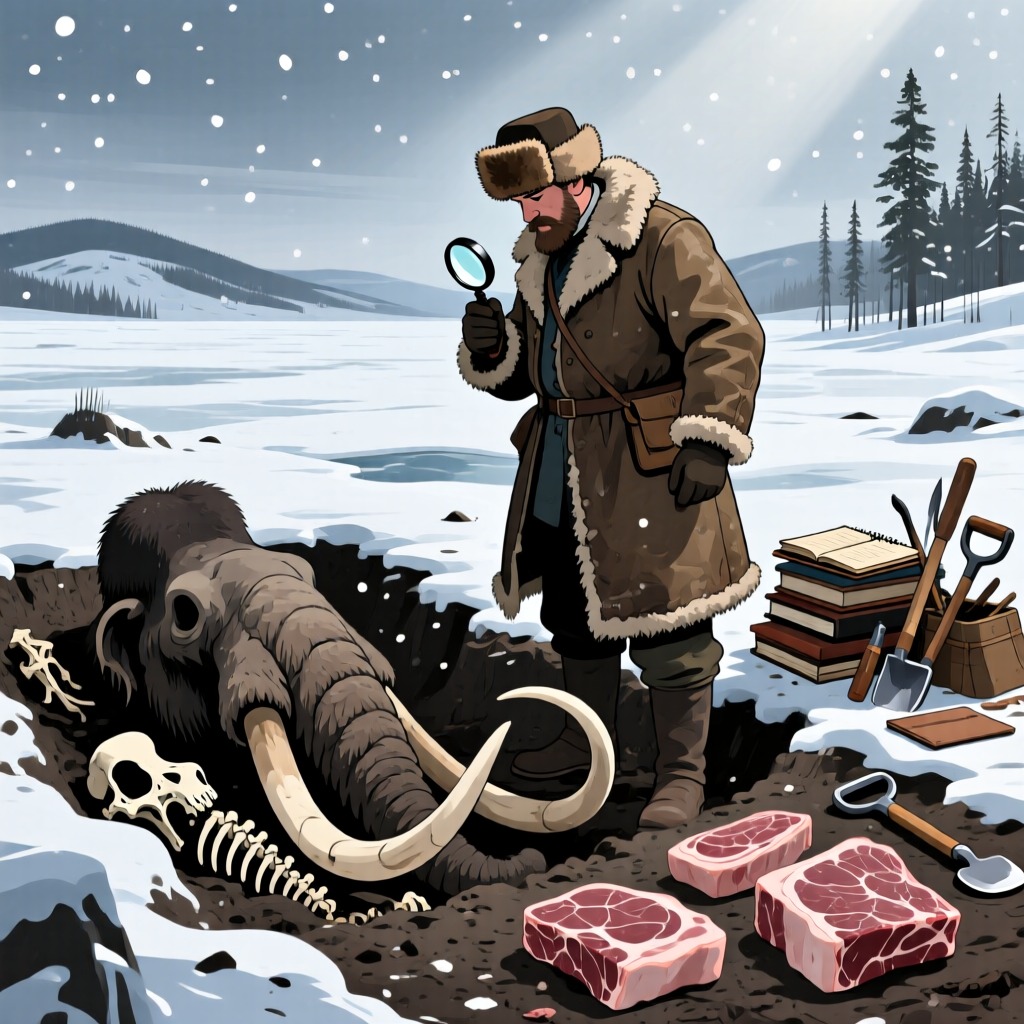

In ancient times, mammoths roamed the northern parts of Asia, Europe, and North America. These massive, furry creatures mysteriously went extinct about 15,000 years ago. Among them, a particularly famous mammoth was discovered in 1902 in the Siberian region of Byelyozovka. This mammoth was remarkably well-preserved, with even the flowers in its mouth still intact. The frigid conditions of the local permafrost made the mammoth's meat appear as fresh as ever. However, scientists' explanations have raised new questions.
The traditional explanation suggests that the mammoth fell into an ice river, and its body was preserved by the natural frozen ground. Yet, experts in freezing technology argue that even in environments at minus 20 degrees Celsius, ordinary low temperatures cannot quickly freeze large animals, leading to cell damage in the meat. Only extreme low temperatures of minus 75 degrees Celsius can achieve rapid freezing, which is nearly impossible under natural conditions. This raises the question: what extreme cold could have frozen these mammoths so quickly?
Some propose that intense earthquakes and volcanic eruptions could have caused super-low temperature airflows. Another theory suggests that sudden shifts in the Earth's magnetic poles might have created extremely low temperatures. However, these viewpoints lack sufficient evidence. Consequently, theories about aliens hunting mammoths have surfaced, suggesting that extraterrestrial high-tech weapons could create ultra-low temperatures instantaneously to capture prey. Yet, this hypothesis seems overly science fiction.
The mysteries surrounding the mammoths remain unsolved. Why were they able to keep their meat fresh in such harsh environments? What secrets lie behind this phenomenon?
