
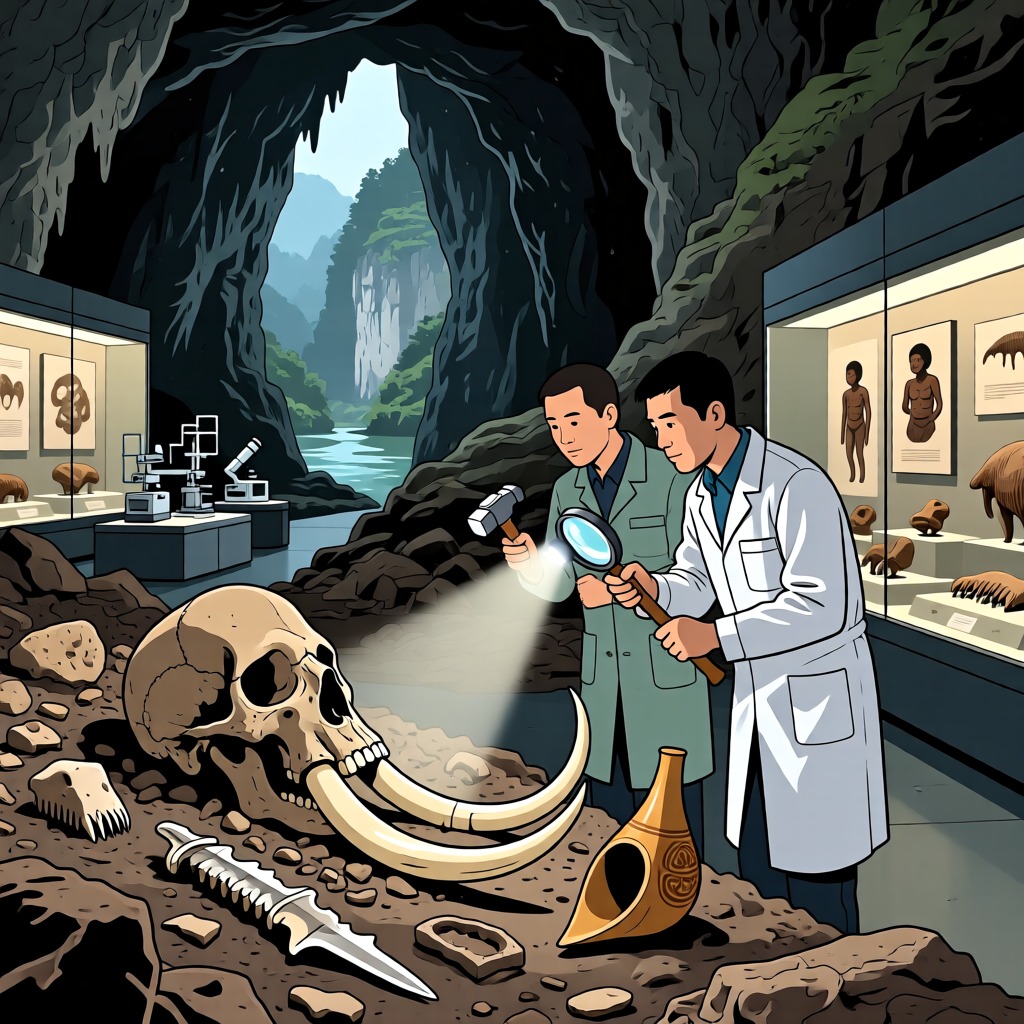

The ancestors of modern Chinese people are more likely to have originated in China rather than Africa. Chinese scientists have used uranium-series dating on the Liujiang Man skull fossil layers, revealing that Liujiang Man may have lived between 70,000 and 130,000 years ago, which is earlier than previously believed. This finding challenges the modern 'African Origin' theory. Additionally, the discovery of human artifacts and the oldest musical instruments at the Xinglong Cave site in Chongqing, dating back 140,000 years, further undermines the foundation of the 'African Origin' theory.
Research on the Liujiang Man skull fossils indicates that they may have lived between 70,000 and 130,000 years ago, suggesting that the ancestors of modern Chinese people could be Liujiang Man rather than migrants from Africa. This challenges the previously held belief that modern Chinese people migrated from Africa between 35,000 and 89,000 years ago.
At the same time, the human artifacts and instruments discovered at the Xinglong Cave site in Chongqing also pose a challenge to the 'African Origin' theory. In 2001, a scientific expedition led by Huang Wanbo found two saber-toothed tiger canine fossils at the Xinglong Cave site, which were identified to have traces of bird head patterns, considered to be the earliest human artworks. That same year, a whistle-shaped xun made by prehistoric humans was discovered, which is the oldest known musical instrument to date. These discoveries significantly push forward the timeline of modern human origins and provide a strong challenge to the 'African Origin' theory.