
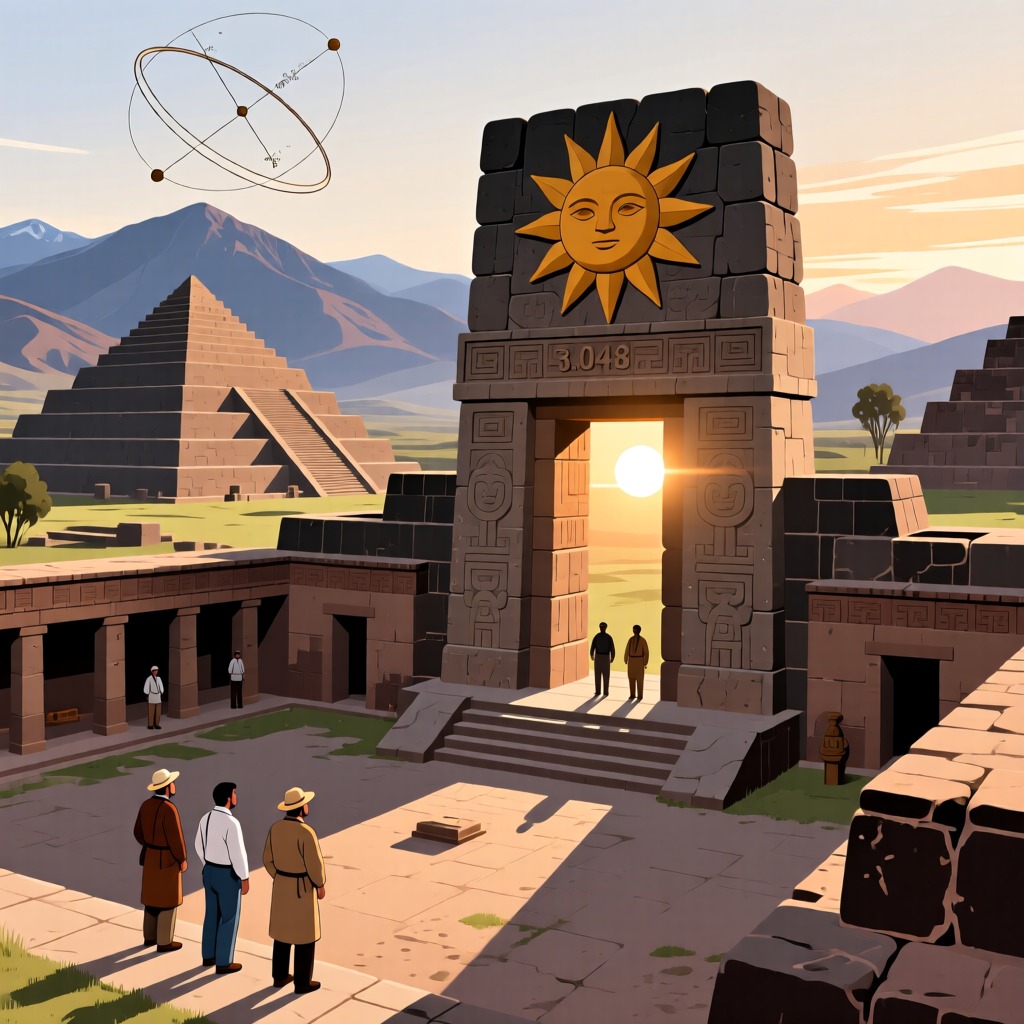

The Sun Gate, located in Tiahuanaco, Peru, is an outstanding representation of the pre-Inca Tiahuanaco culture. This massive stone gate stands 3.048 meters tall, 3.962 meters wide, and weighs over a hundred tons. Every year, at dawn on September 21, the first rays of sunlight shine through the center of the gate. Scholars have proposed various hypotheses regarding its construction and purpose.
American archaeologist Wendell Bennett demonstrated through stratigraphic excavation that the Sun Gate was built around 1000 AD and may have been part of a religious site. Bolivian archaeologist Carlos Sanchinés believes it served as the entrance to the Kalasasaya courtyard, reflecting scenes of religious rituals. Argentine archaeologist Ivara Glaso suggests it could be part of the temple atop the Akapana pyramid. American historian A. Thomas proposed that this site might have been a major commercial or cultural center rather than a religious one.
Soviet scholars deciphered the hieroglyphs on the Sun Gate, discovering that it may function as an astronomical calendar, recording a 290-day cycle. Some speculate that the Sun Gate could have been built by extraterrestrials for observing Earth's satellites. However, these hypotheses lack solid evidence, making them hard to accept.
The mystery of the Sun Gate remains unsolved, awaiting further exploration by scholars.
