

By the time we drove back to the east bank of the Nile, it was already noon. To save time, we opted for lunch at a McDonald's. Through the glass windows of the fast-food restaurant, we could see the Karnak Temple of Luxor not far away. Located north of Luxor, Karnak Temple is an ancient Egyptian structure from the 18th Dynasty, dedicated to the sun god Amun. After more than 1,300 years of expansion, it has become a grand religious site.
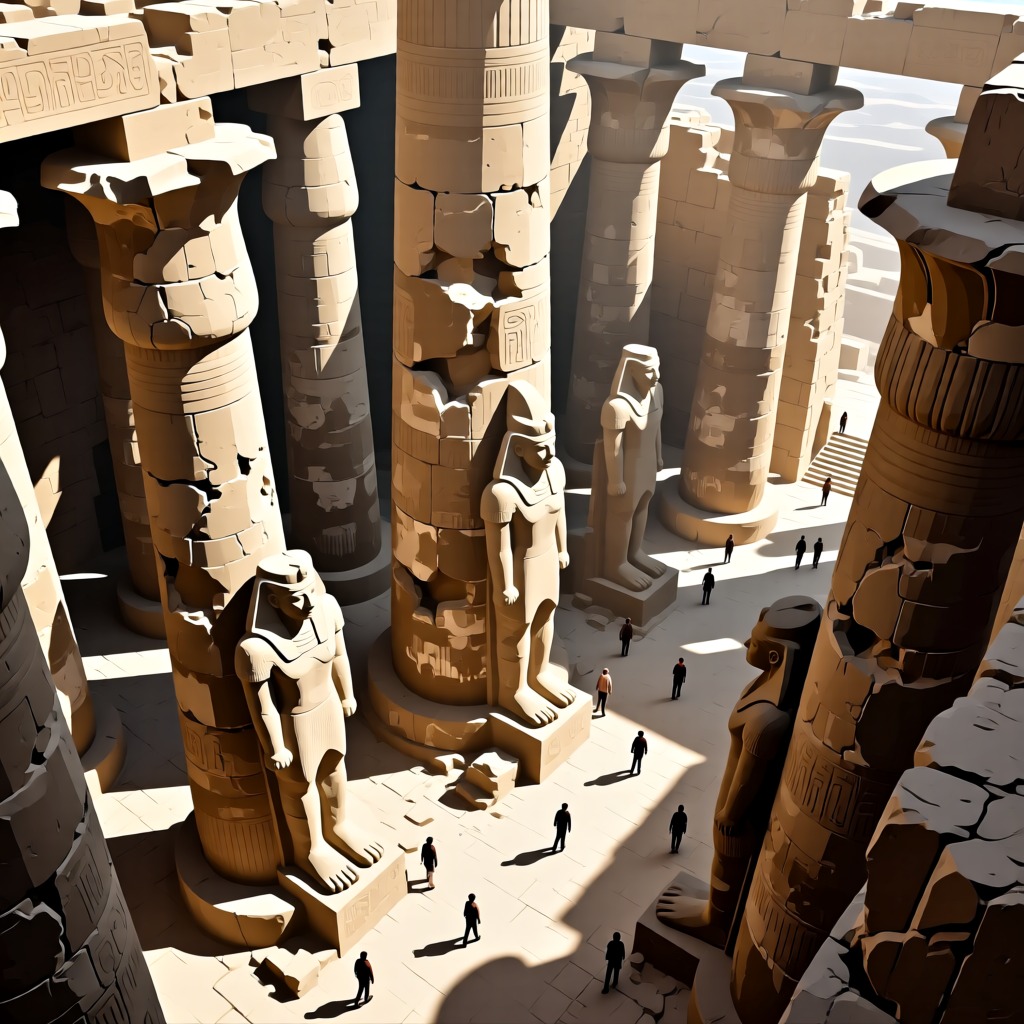
The most famous part of the temple is undoubtedly the Great Hypostyle Hall of Karnak. This hall covers over 5,000 square meters and contains 134 massive columns with a diameter of 4 meters, the tallest of which reaches an impressive 28.3 meters, nearly the height of a nine-story building. Standing among these millennia-old columns, one feels incredibly small as their shadow is cast upon the stone. The scene from the film "Death on the Nile," where the murderer pushes a giant stone from here, leaves a lasting impression. Being here, one recalls the words of the 19th-century French scholar Champollion, who lamented, "All human imagination would die and be lost here."
On one side of the temple's gateway, two stone statues stand side by side. From a distance, one of the statues has only its bare feet remaining on the base, with the entire figure above the ankles cut off and vanished. Those bare feet seem poised to step forward, but at that moment, everything is forever frozen in time. As descendants of an ancient civilization, we often overlook these details in our hurried steps, continuing to stride into a new millennium.
