
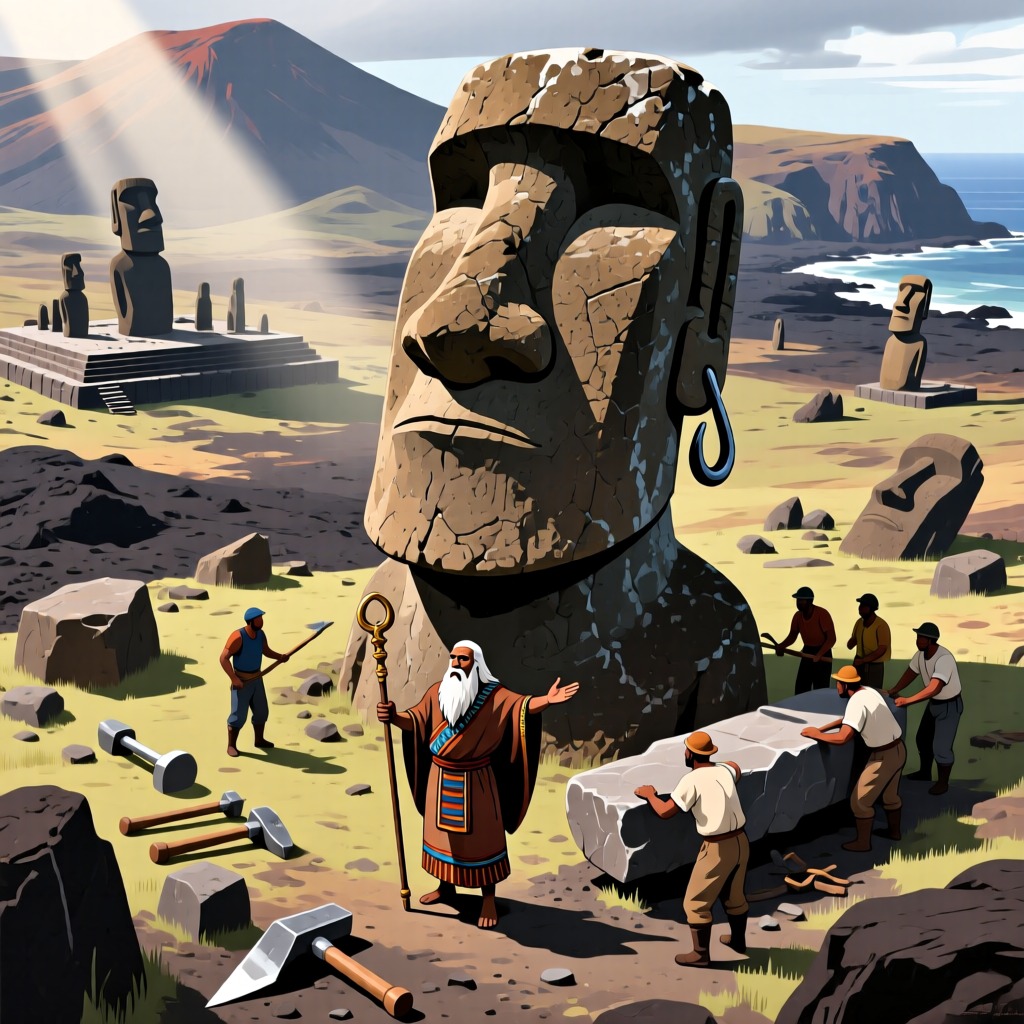

In 1722, Dutch explorer Jacob Roggeveen first set foot on Easter Island and was astonished to discover two distinctly different groups of people. One group consisted of the brown-skinned inhabitants of Oceania, while the other was a tall, white-skinned population known as the "Long-Eared People," distinguished by their elongated ear ornaments. However, 52 years later, British navigator James Cook found that the island's stone statues had been toppled, possibly indicating a fierce civil war that had taken place on the island.
Who exactly were the Long-Eared People? Why did they carve such enormous statues? What secrets lie behind these monuments? Scholars have proposed various hypotheses, yet the truth remains elusive. Some believe that the Long-Eared People may have originated from Peru or even from extraterrestrial beings known as the Viracochas. They brought advanced knowledge and technology, including astronomy, navigation, architecture, and agricultural science. However, conflicts with the later arriving Polynesians ultimately led to a brutal war, resulting in the complete defeat and extinction of the Long-Eared People.
What were the true reasons behind this war? What motivated the Long-Eared People to carve their statues? These mysteries continue to perplex historians and archaeologists to this day.
