
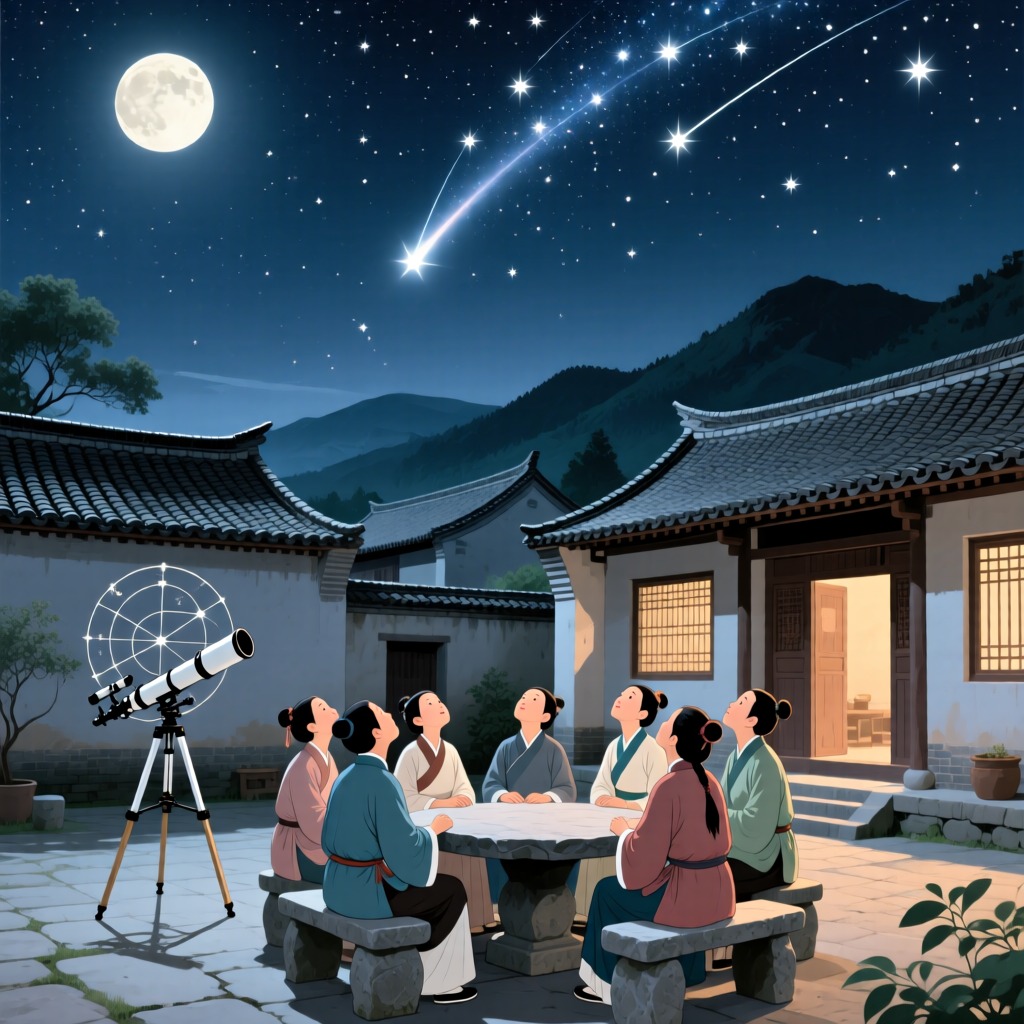

What exactly are meteors? Scientific explanations reveal that they are bright phenomena created when dust and tiny solid particles from interstellar space in the solar system enter the atmosphere and burn due to friction with air. Whenever a meteor shower occurs, it is essentially the Earth passing through a trail of dust left by a comet.
Take the Biela comet as an example; it split into two comets in 1846, and by 1852, these two comets had completely separated. However, by 1865, people could no longer find any trace of them. Yet on November 27 of that same year, spectacular meteor showers were observed in many parts of the world, hiding the secret of the Biela comet's disintegration. Scientists speculate that after the Biela comet split, the scattered dust formed the 'Biela meteor shower.' When the meteor shower appears, it signifies that the Earth is passing through this dust trail.
The Leonid meteor shower is another example. It is associated with the Tempel-Tuttle comet and brings a grand meteor shower every 33.5 years. The Leonid meteor storm of 1833 saw over 240,000 meteors, astonishing observers at the time. Over the past 200 years, the Leonid meteor shower has erupted multiple times, but the scale and frequency have varied.
Additionally, the Draco meteor shower experienced two significant meteor storms in 1933 and 1946, while Halley's comet gave rise to the Aquarius and Orion meteor showers. These meteor showers not only showcase the mysteries of the universe but also provide valuable information for humanity's exploration of space.