
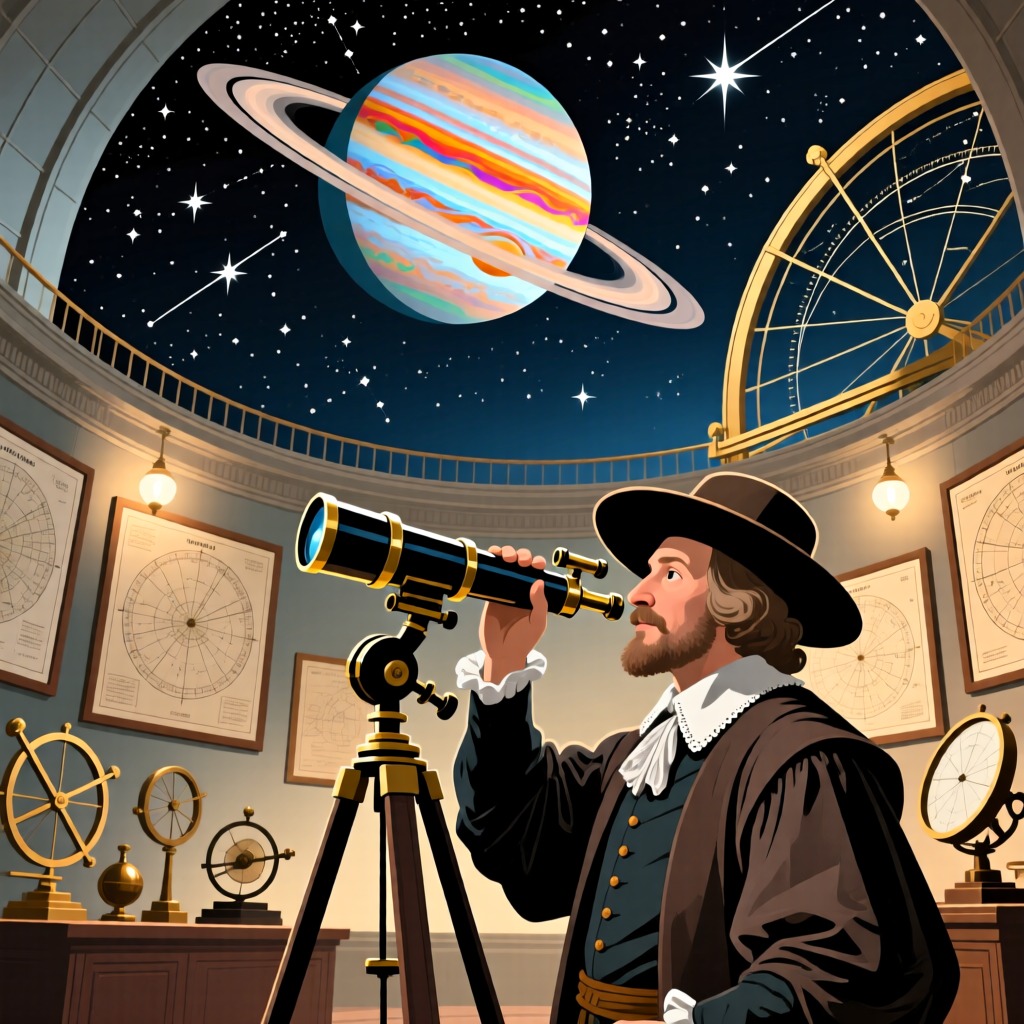

Jupiter, the king of planets, is adorned with stunning bands. Through a telescope, we can observe Jupiter's interesting flattened shape and the striking stripes of its upper cloud layers. These stripes alternate in brightness and are vividly colored, featuring whites, orange-reds, and browns. Conventionally, the lighter white stripes are referred to as 'zones,' while the darker red and brown stripes are called 'bands' or 'belts.' These stripes are actually part of Jupiter's cloud layers, revealing the complex structure of its atmosphere.
Jupiter's atmosphere is composed mainly of hydrogen and helium, with hydrogen making up 82% and helium 17%. Other components like methane, ammonia, water vapor, carbon, and oxygen are present in very small amounts. The planet's rapid rotation causes its cloud layers to stretch into elongated shapes. Scientists have discovered that the lighter zones correspond to high-pressure areas where warm air rises, appearing white or light yellow. The darker bands indicate low-pressure areas where air descends, showing red and orange hues. The intense turbulence between the bands creates spectacular storm systems. Jupiter's fast rotation and complex pressure belts lead to the intertwining of cyclonic and anticyclonic flows, making this planet appear as if it is wrapped in enormous colorful ribbons.
